Inverse Functions & Chain Rule
This lesson examines inverse functions — functions that reverse the action of another — and their connection to reflections of graphs. We develop the Chain Rule for differentiating composite functions and derive a formula relating the derivative of an inverse to the derivative of the original function.
Inverse functions arise whenever one needs to reverse a process:
- Temperature conversion: Celsius to Fahrenheit is a function; Fahrenheit to Celsius is its inverse.
- Encryption: encoding a message is a function; decoding it is the inverse.
- GPS navigation: converting coordinates to a street address, and vice versa.
- Cooking: a recipe converts ingredients to a dish; the inverse problem recovers the ingredients from the dish.
The chain rule is fundamental to domains ranging from physics (rates of change in mechanical systems) to machine learning (backpropagation in neural networks).
Topics Covered
- Inverse function graphs: mirror reflection across \(y = x\)
- Slopes of inverse functions are reciprocals
- The chain rule: derivative of a composite function
- Deriving the inverse function derivative formula via the chain rule
- Evaluating inverse derivatives numerically
- Practice problems with the chain rule
Lecture Video
Key Frames from the Lecture
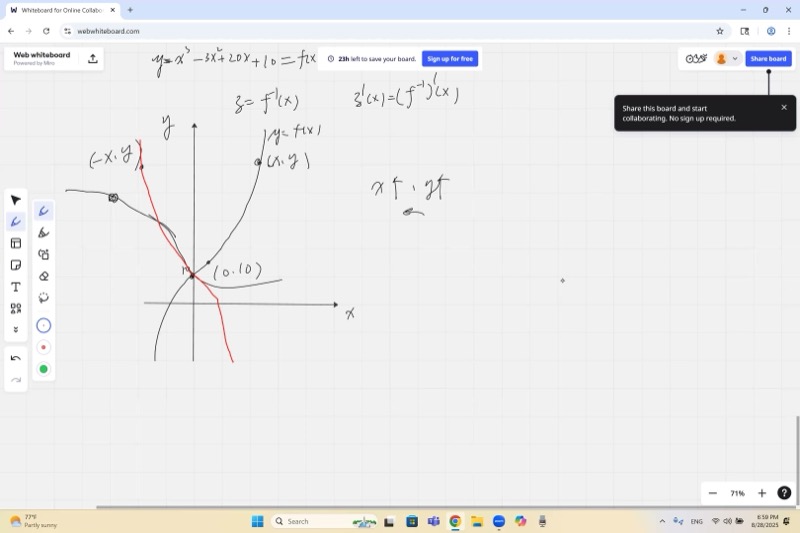
A function \(f\) takes an input and produces an output. The inverse function \(f^{-1}\) reverses this: it takes the output back to the input.
\[f(a) = b \iff f^{-1}(b) = a\]
Key idea: if the point \((a, b)\) is on the graph of \(f\), then the point \((b, a)\) is on the graph of \(f^{-1}\).
Not every function has an inverse. A function must be one-to-one (pass the horizontal line test) to possess an inverse.
A composite function is a function applied to the output of another function. We write it as \(f(g(x))\) or \((f \circ g)(x)\).
This may be understood as a two-stage process:
- First, \(x\) is mapped by \(g\) to produce \(g(x)\).
- Then, \(g(x)\) is mapped by \(f\) to produce \(f(g(x))\).
Example: if \(f(x) = x^2\) and \(g(x) = 3x + 1\), then
\[f(g(x)) = f(3x+1) = (3x+1)^2\]
Recall the following power rule derivatives:
- \(\frac{d}{dx}[x^n] = nx^{n-1}\)
- \(\frac{d}{dx}[c] = 0\) (constant)
- \(\frac{d}{dx}[cf(x)] = c \cdot f'(x)\) (constant multiple)
- \(\frac{d}{dx}[f(x) + g(x)] = f'(x) + g'(x)\) (sum rule)
Inverse Function Graphs: Mirror Reflection
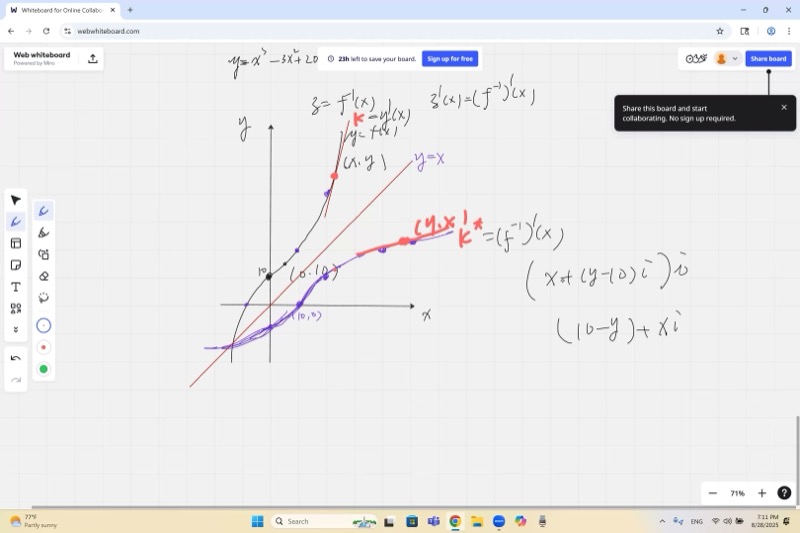
The graph of \(f^{-1}\) is the mirror reflection of \(f\) across the line \(y = x\).
This follows from the fact that every point \((a, b)\) on \(f\) corresponds to the point \((b, a)\) on \(f^{-1}\) — the \(x\) and \(y\) coordinates are interchanged. The line \(y = x\) is the angle bisector of the \(x\)-axis and \(y\)-axis, and reflection across it swaps coordinates.
A common error is to suppose that one may simply rotate the graph 90 degrees. This is incorrect — rotation and reflection are different transformations.
- Reflection across \(y = x\): swap \((a, b) \to (b, a)\)
- Rotation by 90 degrees: moves \((a, b) \to (-b, a)\)
Note the minus sign in rotation — this alters the shape. The correct operation is reflection across \(y = x\), not rotation of the page.
Animated: Inverse function reflection across y = x with corresponding tangent lines
Inverse Function Reflection: f(x)=x² and f¹(x)=√x
Explore — see \(f\) and \(f^{-1}\) as reflections across \(y = x\):
Slopes of Inverse Functions Are Reciprocals
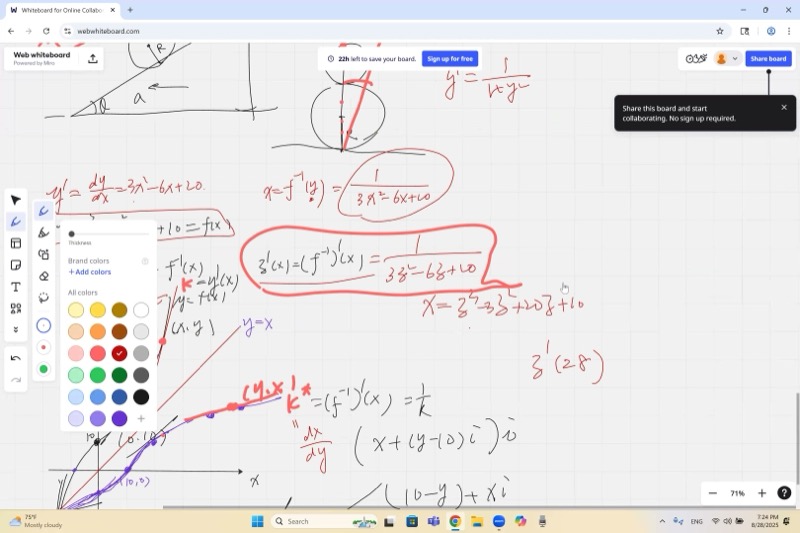
This is an elegant result: if the graph of \(f\) has slope \(k\) at the point \((a, b)\), then the graph of \(f^{-1}\) has slope \(\frac{1}{k}\) at the point \((b, a)\).
\[f'(a) = k \implies (f^{-1})'(b) = \frac{1}{k}\]
Why? When you reflect across \(y = x\), rise and run swap. A slope of \(\frac{\text{rise}}{\text{run}} = k\) becomes \(\frac{\text{run}}{\text{rise}} = \frac{1}{k}\).
To find the slope of the inverse function at a point, take the reciprocal of the slope of the original function at the corresponding point. If the original increases steeply, the inverse increases gently.
\[(f^{-1})'(b) = \frac{1}{f'(f^{-1}(b))}\]
In words: to find the slope of the inverse at \(b\), take the reciprocal of the slope of \(f\) at the corresponding input.
The Chain Rule
The chain rule tells you how to differentiate a composite function \(f(g(x))\):
To differentiate a function nested inside another function, take the derivative of the outside (keeping the inside untouched), then multiply by the derivative of the inside.
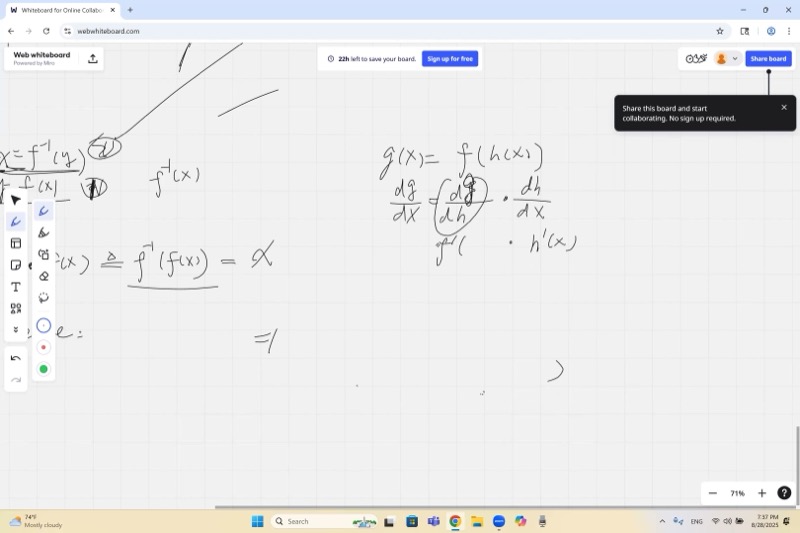
\[\frac{d}{dx}\big[f(g(x))\big] = f'(g(x)) \cdot g'(x)\]
In summary: derivative of the outside (leaving the inside alone) times the derivative of the inside.
Consider a gear system: a small gear turns a medium gear, which turns a large gear.
- The rate at which the large gear turns depends on the medium gear (outer derivative).
- The rate at which the medium gear turns depends on the small gear (inner derivative).
- The total rate equals the product: outer rate \(\times\) inner rate.
This multiplicative relationship is precisely the chain rule.
Animated: Chain Rule unwinding – nested function evaluation step by step
Chain Rule Unwinding: y = (3x²+1)³
Example: Differentiate \((3x^4 - 7x + 1)^3 - 7x^2 + 2\)
Break it into pieces:
Piece 1: \((3x^4 - 7x + 1)^3\) — this is a composite! The outer function is \(u^3\), the inner is \(u = 3x^4 - 7x + 1\).
\[\frac{d}{dx}(3x^4 - 7x + 1)^3 = 3(3x^4 - 7x + 1)^2 \cdot (12x^3 - 7)\]
Piece 2: \(-7x^2 + 2\) — straightforward power rule:
\[\frac{d}{dx}(-7x^2 + 2) = -14x\]
Full answer:
\[\frac{d}{dx}\big[(3x^4 - 7x + 1)^3 - 7x^2 + 2\big] = 3(3x^4 - 7x + 1)^2(12x^3 - 7) - 14x\]
Deriving the Inverse Derivative Formula
Here the chain rule and inverse functions come together elegantly. Start from the defining property of an inverse:
\[f^{-1}(f(x)) = x\]
Now differentiate both sides using the chain rule:
\[\frac{d}{dx}\big[f^{-1}(f(x))\big] = \frac{d}{dx}[x]\]
\[(f^{-1})'(f(x)) \cdot f'(x) = 1\]
Solve for \((f^{-1})'\):
\[(f^{-1})'(f(x)) = \frac{1}{f'(x)}\]
This is precisely the reciprocal relationship observed geometrically. If \(f(a) = b\), then:
\[(f^{-1})'(b) = \frac{1}{f'(a)}\]
Evaluating Inverse Derivatives Numerically
Example: Find \((f^{-1})'(28)\) where \(f(x) = x^3 + x\)
Step 1: Find which input \(a\) gives \(f(a) = 28\).
\[a^3 + a = 28\]
We test \(a = 3\): \(27 + 3 = 30\) (too large). We test \(a = 2\): \(8 + 2 = 10\) (too small). The exact solution is not an integer; however, the method is what matters:
General method:
- Find \(a\) such that \(f(a) = 28\) (so \(f^{-1}(28) = a\))
- Compute \(f'(a)\): take the derivative of \(f\) and substitute \(a\)
- Take the reciprocal: \((f^{-1})'(28) = \frac{1}{f'(a)}\)
Worked example with \(f(x) = x^3 + x\), finding \((f^{-1})'(30)\):
- Solve \(a^3 + a = 30\). Testing \(a = 3\): \(27 + 3 = 30\).
- \(f'(x) = 3x^2 + 1\), so \(f'(3) = 3(9) + 1 = 28\)
- \((f^{-1})'(30) = \frac{1}{28}\)
Explore — see the function and its inverse, with tangent lines showing reciprocal slopes:
Cheat Sheet
| Concept | Formula / Rule |
|---|---|
| Inverse graph | Reflect across \(y = x\) (swap coordinates), NOT rotate |
| Inverse slopes | If \(f'(a) = k\), then \((f^{-1})'(b) = \frac{1}{k}\) where \(b = f(a)\) |
| Inverse derivative formula | \((f^{-1})'(b) = \frac{1}{f'(f^{-1}(b))}\) |
| Chain rule | \(\frac{d}{dx}[f(g(x))] = f'(g(x)) \cdot g'(x)\) |
| Chain rule in words | Derivative of outside \(\times\) derivative of inside |
| Deriving inverse derivative | Start from \(f^{-1}(f(x)) = x\), differentiate both sides |
Steps to Find \((f^{-1})'(b)\) Numerically
- Find \(a\) such that \(f(a) = b\)
- Compute \(f'(a)\)
- Answer: \((f^{-1})'(b) = \frac{1}{f'(a)}\)