Optimization & Distance to Curves
This lesson develops optimization techniques using derivatives — methods for finding the shortest distance, the lowest cost, or the optimal design. We study the problem of minimizing the distance from an external point to a curve as a motivating example.
Optimization concerns finding the best value — the shortest path, the cheapest design, the fastest route.
- GPS navigation: determines the shortest route between two locations.
- Logistics: maximizes the number of items packed into a delivery vehicle.
- Architecture: designs the strongest bridge using the least material.
- Computer graphics: determines the optimal camera angle for a scene.
The power of calculus lies in replacing exhaustive search with a direct computation: derivatives identify the optimal solution.
Topics Covered
- Optimization review: finding max/min using derivative = 0
- AM-GM inequality proved with calculus
- Minimizing distance from a point to a curve
- The “minimize \(D^2\) instead of \(D\)” trick
- Solving cubic equations by hand
- Geometric approach: minimum distance line is perpendicular to the tangent
- Tangent and normal vectors from differentials
Lecture Video
Key Frames from the Lecture
Prerequisites
Optimization means finding the input value that makes a function as large as possible (maximum) or as small as possible (minimum).
In calculus, we use the fact that at a max or min, the derivative equals zero:
\[f'(x) = 0\]
The reason is that the derivative measures the slope of the curve. At a local extremum, the slope is zero. This observation is the key insight that makes calculus effective for optimization.
The derivative \(f'(x)\) gives the rate of change — how rapidly \(f(x)\) is increasing or decreasing at any point \(x\).
- \(f'(x) > 0\): function is increasing
- \(f'(x) < 0\): function is decreasing
- \(f'(x) = 0\): function is flat (potential extremum)
For \(f(x) = x^n\), the derivative is \(f'(x) = nx^{n-1}\). For example, \(f(x) = x^2\) gives \(f'(x) = 2x\).
The distance between two points \((x_1, y_1)\) and \((x_2, y_2)\) is:
\[D = \sqrt{(x_2 - x_1)^2 + (y_2 - y_1)^2}\]
This comes straight from the Pythagorean theorem — the distance is the hypotenuse of a right triangle with legs \((x_2 - x_1)\) and \((y_2 - y_1)\).
Key Concepts
Optimization Review: Setting \(f'(x) = 0\)
To find the maximum or minimum of a function \(f(x)\):
- Take the derivative \(f'(x)\)
- Set \(f'(x) = 0\) and solve for \(x\)
- Check whether it’s a max or min (using the second derivative or by testing nearby points)
AM-GM Inequality via Calculus
The AM-GM inequality says that for positive numbers \(a\) and \(b\):
\[\frac{a + b}{2} \geq \sqrt{ab}\]
The arithmetic mean is always at least as large as the geometric mean. We can prove this using calculus. For a fixed product \(ab = P\), we seek to minimize \(a + b = a + \frac{P}{a}\):
\[f(a) = a + \frac{P}{a}\]
\[f'(a) = 1 - \frac{P}{a^2} = 0 \implies a^2 = P \implies a = \sqrt{P}\]
When \(a = \sqrt{P}\), we get \(b = \frac{P}{\sqrt{P}} = \sqrt{P} = a\). So the sum \(a + b\) is smallest when \(a = b\) — and that’s exactly when AM equals GM!
Explore — see how the sum \(a + \frac{P}{a}\) has its minimum when \(a = \sqrt{P}\):
Minimizing Distance from a Point to a Curve
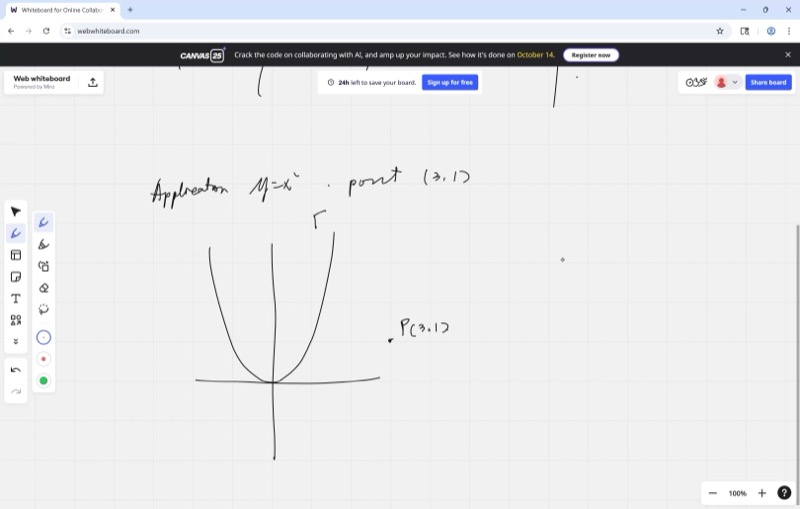
Problem: Find the point on the parabola \(y = x^2\) closest to the point \(P(3, 1)\).
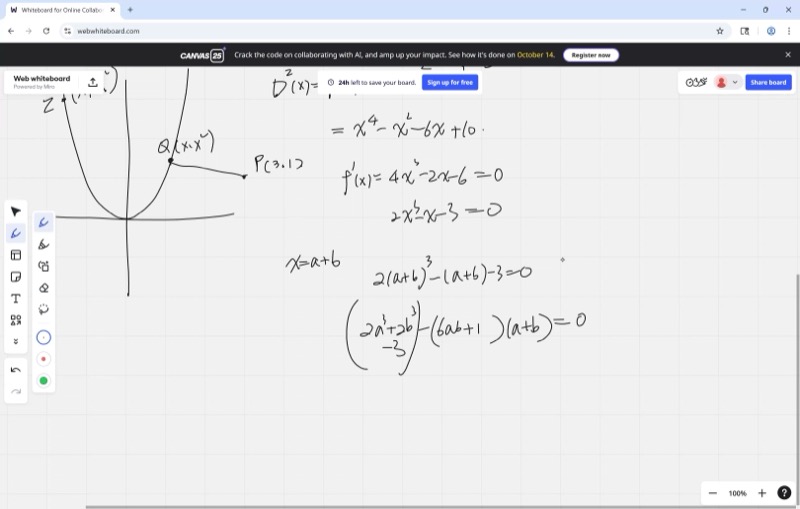
The distance from \(P(3,1)\) to a point \((x, x^2)\) on the parabola is:
\[D = \sqrt{(x - 3)^2 + (x^2 - 1)^2}\]
The square root in the distance formula complicates differentiation. The key observation is that \(D\) is minimized exactly when \(D^2\) is minimized (since \(D \geq 0\) and squaring preserves order for non-negative numbers).
Therefore, instead of minimizing \(D\), we minimize:
\[D^2 = (x - 3)^2 + (x^2 - 1)^2\]
Eliminating the square root yields a much cleaner derivative.
Since distance is always non-negative, the value of \(x\) that minimizes the distance \(D\) is the same value that minimizes \(D^2\). Working with \(D^2\) gets rid of the square root and makes the derivative much easier to compute.
\[D^2 = (x-3)^2 + (x^2-1)^2\]
Take the derivative and set it to zero:
\[\frac{d(D^2)}{dx} = 2(x-3) + 2(x^2-1)(2x) = 0\]
\[2(x - 3) + 4x(x^2 - 1) = 0\]
\[(x - 3) + 2x(x^2 - 1) = 0\]
\[2x^3 - 2x + x - 3 = 0\]
\[2x^3 - x - 3 = 0\]
This is a cubic equation — and we need to solve it!
Animated: Find the point on y = x^2 closest to P(3, 1)
Optimization: Minimum Distance from P(3,1) to y=x²
Explore — drag the point along the parabola to see the distance change:
Solving the Cubic \(2x^3 - x - 3 = 0\)
First, try rational roots. Testing \(x = 1\): \(2(1) - 1 - 3 = -2 \neq 0\). Testing \(x = -1\): \(-2 + 1 - 3 = -4 \neq 0\).
But we can factor: try \(x = 1\) again more carefully — actually, we need the substitution method.
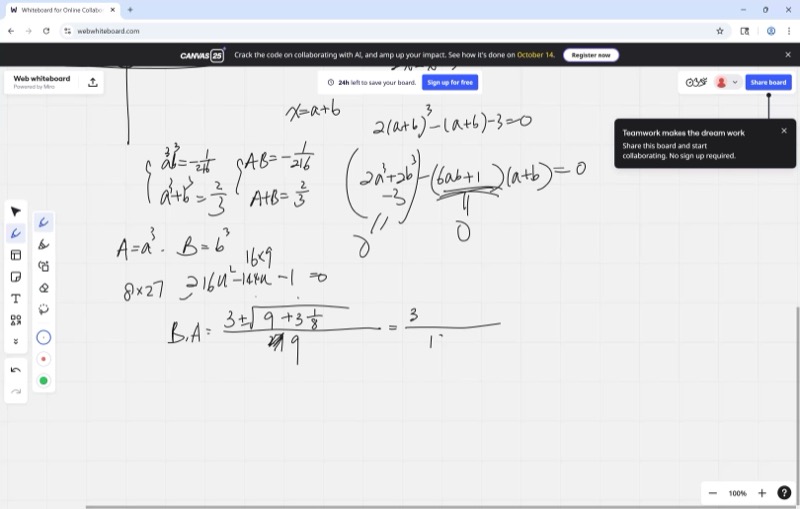
Substitution approach: Let \(x = a + b\). We want \(a^3 + b^3\) and \(ab\) to simplify the equation. Using Vieta’s formulas, we can reduce the cubic to a quadratic in \(a^3\) and \(b^3\):
From \(2x^3 - x - 3 = 0\), divide by 2:
\[x^3 - \frac{1}{2}x - \frac{3}{2} = 0\]
By inspection or numerical methods, \(x = 1\) doesn’t work, but we can verify that \(2(1)^3 - 1 - 3 = -2\). We check that the cubic has one real root near \(x \approx 1.18\).
For this course, the important takeaway is the method: substitute \(x = a + b\), use the identity \((a+b)^3 = a^3 + 3ab(a+b) + b^3\), and match coefficients to turn the cubic into a quadratic.
Animated: Derivative sign analysis with increasing/decreasing shading and min/max markers
Derivative Sign Analysis: f(x) = x³ - 6x² + 9x + 1
The Geometric Approach: Normal Lines
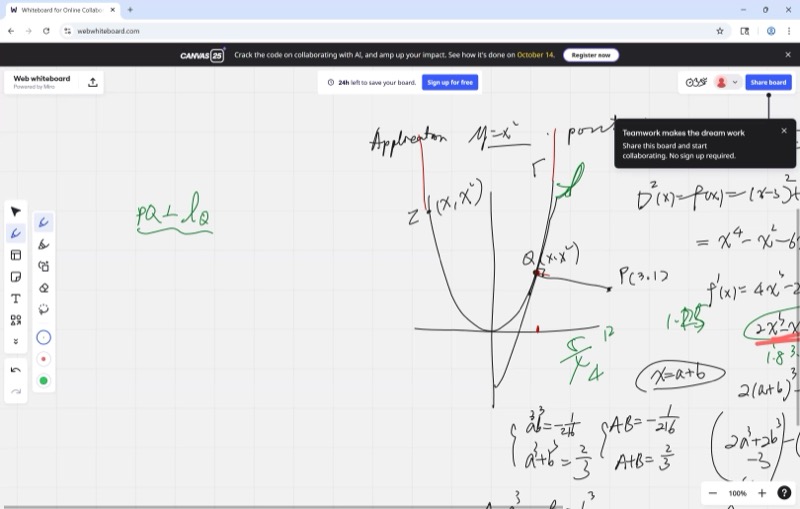
There is a beautiful geometric shortcut. At the closest point on the curve, the line from \(P\) to the curve must be perpendicular to the tangent line.
The shortest path from an external point to a curve always hits the curve at a right angle. If it arrived at any other angle, you could slide along the curve to get closer, so it wouldn’t be the minimum.
The reason is that if the line from \(P\) met the curve at a non-perpendicular angle, one could slide along the curve to achieve a shorter distance — contradicting the assumption of minimality.
- Tangent line: the line that is tangent to the curve at a point, sharing its direction at that point
- Normal line: the line perpendicular (at a right angle) to the tangent line at that point
Tangent and Normal Vectors from Differentials
For the parabola \(y = x^2\), the differential is:
\[dy = 2x \, dx\]
This tells us the tangent direction: moving \(dx\) in the \(x\)-direction causes \(dy = 2x \, dx\) in the \(y\)-direction. So the tangent vector is:
\[\vec{T} = (1, \; 2x)\]
To get the normal vector (perpendicular to the tangent), we swap and negate:
\[\vec{N} = (-2x, \; 1)\]
The minimum-distance line from \(P(3,1)\) to the parabola must point in the normal direction. At a point \((x_0, x_0^2)\) on the parabola, the direction to \(P\) is \((3 - x_0, \; 1 - x_0^2)\). For this to be parallel to \(\vec{N} = (-2x_0, 1)\):
\[\frac{3 - x_0}{-2x_0} = \frac{1 - x_0^2}{1}\]
This gives us the same cubic equation — but we arrived at it geometrically instead of algebraically!
Explore — see the tangent and normal lines at any point on the parabola:
Drag the slider for \(a\) until the normal line (purple) passes through \(P\) — that identifies the closest point.
Homework: Ellipse Distance Problem
Use the geometric method to find the point on the ellipse \(\frac{x^2}{4} + y^2 = 1\) closest to a given external point.
Hint: For the ellipse, the differential is:
\[\frac{2x}{4}\,dx + 2y\,dy = 0 \implies \frac{x}{2}\,dx + 2y\,dy = 0\]
So the tangent vector is \((2y, -\frac{x}{2})\) and the normal vector is \((\frac{x}{2}, 2y)\). Set up the perpendicularity condition just like we did for the parabola!
Cheat Sheet
| What you want | What to do |
|---|---|
| Find max or min of \(f(x)\) | Solve \(f'(x) = 0\) |
| Minimize a distance | Minimize \(D^2\) instead (avoids the square root) |
| AM-GM inequality | \(\frac{a+b}{2} \geq \sqrt{ab}\), equality when \(a = b\) |
| Tangent vector to \(y = f(x)\) | \((1, \; f'(x))\) |
| Normal vector to \(y = f(x)\) | \((-f'(x), \; 1)\) |
| Closest point on a curve | Line from external point must be perpendicular to tangent |
The Optimization Recipe
\[\text{Write } D^2 \text{ as a function of one variable} \;\longrightarrow\; \text{Take derivative} \;\longrightarrow\; \text{Set } = 0 \;\longrightarrow\; \text{Solve!}\]