The Number e & Binomial Expansion
This lesson traces the origin of the number \(e \approx 2.71828\) through the compound interest limit. We develop the binomial expansion as a tool for analyzing \(\left(1 + \frac{r}{k}\right)^k\) as \(k \to \infty\), arriving at the exponential series and the defining properties of \(e\).
Consider placing $1 in a bank account that pays 100% interest per year. If the bank compounds once a year, the balance becomes $2. Compounding monthly, daily, or every second yields progressively larger amounts, but the balance does not grow without bound — it converges to the constant \(e \approx 2.71828...\). This number appears throughout mathematics and the sciences: in population growth, radioactive decay, and the modeling of viral phenomena. This lesson establishes precisely where \(e\) comes from and why it is distinguished among all constants.
Topics Covered
- The origin of the number \(e\) through compound interest
- The limit \(\left(1 + \frac{r}{k}\right)^k \to e^r\) as \(k \to \infty\)
- Why the derivative of \(e^x\) is \(e^x\) itself — the defining property
- Binomial expansion: \((a+b)^n = \sum_{i=0}^{n} \binom{n}{i} \cdot a^{n-i} \cdot b^{i}\)
- Combinatorics review: \(\binom{n}{k} = \frac{n!}{k!(n-k)!}\)
- Complementarity: \(\binom{n}{k} = \binom{n}{n-k}\)
- Patterns in binomial coefficients that lead to the limit definition of \(e\)
Lecture Video
Key Frames from the Lecture


The reader should be familiar with the basic laws of exponents:
- \(a^m \cdot a^n = a^{m+n}\)
- \((a^m)^n = a^{mn}\)
- \(a^0 = 1\) for any \(a \neq 0\)
These rules are essential for understanding how \((1 + r/k)^k\) behaves as we change \(k\).
A factorial is written \(n!\) and means the product of all positive integers up to \(n\):
\[n! = n \times (n-1) \times (n-2) \times \cdots \times 2 \times 1\]
For example: \(5! = 5 \times 4 \times 3 \times 2 \times 1 = 120\).
By convention, \(0! = 1\). Factorials grow incredibly fast — \(10! = 3{,}628{,}800\) is already over three million.
The Origin of the Number \(e\): Compound Interest
Suppose you invest $1 at 100% annual interest rate (\(r = 1\)). If the bank compounds \(k\) times per year, each compounding period gives you a rate of \(\frac{1}{k}\), and after one year you have:
\[A = \left(1 + \frac{1}{k}\right)^k\]
We examine the behavior as \(k\) grows:
| Compounding (\(k\)) | Expression | Value |
|---|---|---|
| 1 (annually) | \((1 + 1)^1\) | \(2.000\) |
| 2 (semi-annually) | \((1 + 0.5)^2\) | \(2.250\) |
| 12 (monthly) | \((1 + 1/12)^{12}\) | \(2.613...\) |
| 365 (daily) | \((1 + 1/365)^{365}\) | \(2.7146...\) |
| 10,000 | \((1 + 1/10000)^{10000}\) | \(2.71815...\) |
| \(\infty\) | \(\lim_{k \to \infty} (1 + 1/k)^k\) | \(e \approx 2.71828...\) |
The number never blows up to infinity — it settles down to the special constant \(e\).
Explore the limit — use the slider to increase \(k\) and watch the value approach \(e\):
Start with \(k = 1\) and gradually increase it. Observe how rapidly the value approaches \(e\) — by \(k = 100\) the approximation is already within a few hundredths. The value never reaches \(e\) exactly; it approaches it asymptotically. This is the nature of a limit.
Interactive: \((1+1/n)^n\) Convergence to \(e\)
Watch (1 + 1/n)n Approach e
Press Play to watch bars appear one-by-one as n increases. Each bar’s height is \((1+1/n)^n\). Notice how rapidly the values approach the dashed line at \(e\).
Generalizing: The Rate \(r\)
If the interest rate is not 100% but some general rate \(r\), then after one year with \(k\) compoundings:
\[A = \left(1 + \frac{r}{k}\right)^k\]
As \(k \to \infty\), this approaches \(e^r\):
\[\lim_{k \to \infty} \left(1 + \frac{r}{k}\right)^k = e^r\]
This is one of the most important limits in calculus. But to prove it, we need a powerful algebraic tool: the binomial expansion.
Combinatorics Review: \(n\) Choose \(k\)
Before we can expand \((a + b)^n\), we need the binomial coefficient, read “\(n\) choose \(k\)”:
\[\binom{n}{k} = \frac{n!}{k!(n-k)!}\]
This counts the number of ways to choose \(k\) items from a group of \(n\) items, where order does not matter.
Example: How many ways can you pick 3 students from a class of 5?
\[\binom{5}{3} = \frac{5!}{3! \cdot 2!} = \frac{120}{6 \cdot 2} = 10\]
Complementarity: \(\binom{n}{k} = \binom{n}{n-k}\)
An elegant observation: choosing which items to take is equivalent to choosing which items to leave behind.
\[\binom{100}{96} = \binom{100}{4}\]
Selecting 96 people from 100 for a team is equivalent to selecting the 4 who are excluded. Both choices count the same number of subsets, but the latter requires specifying far fewer elements.
This is why \(\binom{n}{k} = \binom{n}{n-k}\) — the formula is symmetric.
\[\binom{n}{n-k} = \frac{n!}{(n-k)!\left(n-(n-k)\right)!} = \frac{n!}{(n-k)! \cdot k!}\]
This is exactly \(\binom{n}{k} = \frac{n!}{k!(n-k)!}\) with the two factors in the denominator transposed. Since multiplication is commutative, the expressions are equal.
The Binomial Expansion
Now for the main tool. The Binomial Theorem says:
The binomial theorem lets you expand any power of a sum \((a+b)^n\) into individual terms. It is the algebraic engine that powers our proof of the compound interest limit.
\[(a + b)^n = \sum_{i=0}^{n} \binom{n}{i} \cdot a^{n-i} \cdot b^{i}\]
This means we expand \((a+b)^n\) by summing over all ways to pick some copies of \(b\) and the rest from \(a\).
Example: Expand \((a + b)^3\)
\[(a+b)^3 = \binom{3}{0}a^3 + \binom{3}{1}a^2 b + \binom{3}{2}a b^2 + \binom{3}{3}b^3\]
\[= a^3 + 3a^2b + 3ab^2 + b^3\]
Example: Expand \((x + 1)^4\)
\[(x+1)^4 = \binom{4}{0}x^4 + \binom{4}{1}x^3 + \binom{4}{2}x^2 + \binom{4}{3}x + \binom{4}{4}\]
\[= x^4 + 4x^3 + 6x^2 + 4x + 1\]
Notice the coefficients \(1, 4, 6, 4, 1\) — these are the 4th row of Pascal’s Triangle.
Patterns in the Binomial Coefficients
When we write out \(\binom{n}{k}\) for a general \(n\), something useful happens. Let us write the first few coefficients with \(k\) factors on top and \(k!\) on the bottom:
\[\binom{n}{0} = 1, \qquad \binom{n}{1} = \frac{n}{1}, \qquad \binom{n}{2} = \frac{n(n-1)}{2!}, \qquad \binom{n}{3} = \frac{n(n-1)(n-2)}{3!}\]
The pattern: \(\binom{n}{k}\) has exactly \(k\) factors on top (starting at \(n\) and counting down) and \(k!\) on the bottom. This form will be critical when we substitute \(n = k\) and take \(k \to \infty\).
Building Toward the Limit: Applying Binomial Expansion to \((1 + r/k)^k\)
Now we connect everything. Set \(a = 1\) and \(b = r/k\) in the binomial theorem, with exponent \(k\):
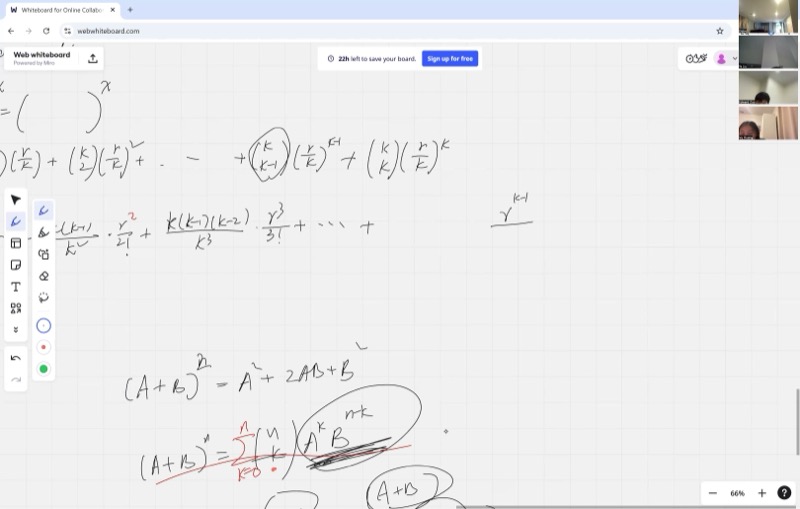
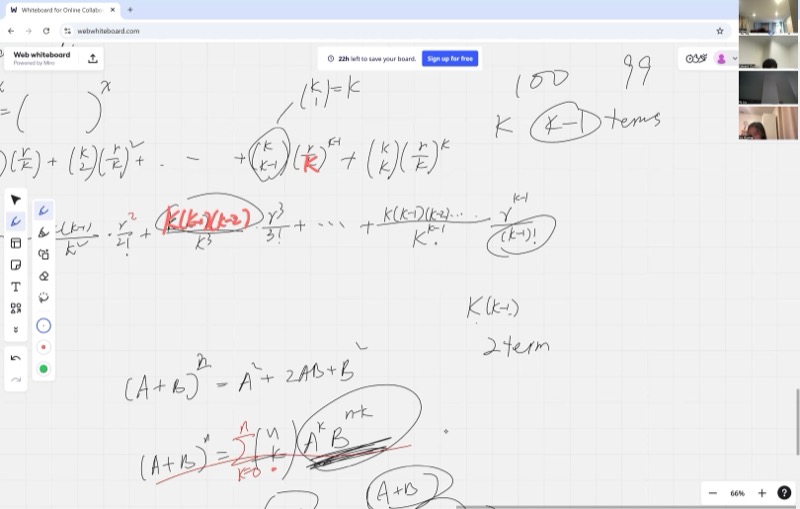
\[\left(1 + \frac{r}{k}\right)^k = \sum_{i=0}^{k} \binom{k}{i} \cdot 1^{k-i} \cdot \left(\frac{r}{k}\right)^i = \sum_{i=0}^{k} \binom{k}{i} \cdot \frac{r^i}{k^i}\]
Writing out the first few terms using our pattern:
\[= 1 + \frac{k}{1} \cdot \frac{r}{k} + \frac{k(k-1)}{2!} \cdot \frac{r^2}{k^2} + \frac{k(k-1)(k-2)}{3!} \cdot \frac{r^3}{k^3} + \cdots\]
\[= 1 + r + \frac{k(k-1)}{k^2} \cdot \frac{r^2}{2!} + \frac{k(k-1)(k-2)}{k^3} \cdot \frac{r^3}{3!} + \cdots\]
Now look at each fraction like \(\frac{k(k-1)}{k^2}\). As \(k \to \infty\):
\[\frac{k(k-1)}{k^2} = \frac{k}{k} \cdot \frac{k-1}{k} = 1 \cdot \left(1 - \frac{1}{k}\right) \to 1\]
So in the limit, every such fraction becomes 1, and we get:
When you compound interest infinitely often, the result is the exponential function \(e^r\). This connects a simple banking idea to one of the most important numbers in mathematics.
\[\lim_{k \to \infty}\left(1 + \frac{r}{k}\right)^k = 1 + r + \frac{r^2}{2!} + \frac{r^3}{3!} + \cdots = \sum_{i=0}^{\infty} \frac{r^i}{i!} = e^r\]
That infinite sum is the Taylor series for \(e^r\) — and that is how compound interest leads us to the number \(e\).
Interactive: Binomial Expansion Terms
Binomial Expansion of (1 + r/k)k — Term by Term
Each colored bar segment shows one term C(k,i)·(r/k)i. As k grows, the terms approach ri/i!, the Taylor series for er.
Each colored segment represents one term of the binomial expansion. Press Play to watch k increase from 2 to 50 – the stacked bar converges toward the dashed line at \(e^r\).
Why the Derivative of \(e^x\) Is \(e^x\) Itself
This is the property that makes \(e\) truly special. Out of all possible exponential functions (\(2^x\), \(3^x\), \(10^x\), …), only \(e^x\) is its own derivative:
The function \(e^x\) is the only exponential function whose rate of change at every point equals its value at that point. This single property is what makes \(e\) the “natural” base for calculus.
\[\frac{d}{dx}(e^x) = e^x\]
No other function grows at a rate exactly equal to its current value. If you have 100 bacteria and the population is modeled by \(e^x\), the rate of growth at that moment is also 100. The bigger it gets, the faster it grows — and the growth rate is always perfectly matched to the size.
Compare \(e^x\) with its derivative — they are the same curve:
Adjust \(b\) and observe that for most bases, the derivative (dashed) differs from the function (solid). Setting \(b = 2.72\) (close to \(e\)) causes the curves to nearly overlap. Only at \(b = e\) exactly are they identical.
Cheat Sheet
| Concept | Key Fact |
|---|---|
| Definition of \(e\) | \(e = \lim_{k \to \infty}\left(1 + \frac{1}{k}\right)^k \approx 2.71828\) |
| General compound interest limit | \(\lim_{k \to \infty}\left(1 + \frac{r}{k}\right)^k = e^r\) |
| Derivative of \(e^x\) | \(\dfrac{d}{dx}(e^x) = e^x\) |
| Binomial Theorem | \((a+b)^n = \displaystyle\sum_{i=0}^{n}\binom{n}{i}\,a^{n-i}\,b^{i}\) |
| Binomial coefficient | \(\binom{n}{k} = \dfrac{n!}{k!(n-k)!}\) |
| Complementarity | \(\binom{n}{k} = \binom{n}{n-k}\) |
| Taylor series for \(e^r\) | \(e^r = \displaystyle\sum_{i=0}^{\infty}\dfrac{r^i}{i!} = 1 + r + \dfrac{r^2}{2!} + \dfrac{r^3}{3!} + \cdots\) |