Taylor/Maclaurin Series & Power Series of ln(1+x)
This lesson demonstrates how to determine the 2025th derivative of a function without performing a single differentiation. We derive the power series for \(\ln(1+x)\) by integrating a geometric series term by term, then use the Maclaurin coefficient formula to read off derivatives of arbitrary order. We also establish the periodic cycle of higher-order derivatives of sine and cosine.
Power series convert complicated functions into infinite polynomials that are amenable to analysis. The function \(\ln(1+x)\) arises in numerous contexts:
- Computer science: algorithm complexity is often measured using logarithms — the approximation \(\ln(1+x) \approx x\) for small \(x\) simplifies running-time estimates.
- Finance: for small interest rates, \(\ln(1+r) \approx r\) provides a useful approximation.
- Physics: when measuring small perturbations, \(\ln(1+x) \approx x\) greatly simplifies calculations.
- Engineering: signal processing employs logarithmic series to analyze audio and radio waves.
- Biology: population models use \(\ln(1+\text{growth rate})\) to predict species dynamics.
We derive the power series for \(\ln(1+x)\) from a geometric series and then apply Maclaurin series to compute high-order derivatives without performing any differentiation.
Topics Covered
- Derivatives of \(\sin x\) and \(\cos x\) from Euler’s formula
- Periodicity of higher-order derivatives of \(\sin x\) and \(\cos x\)
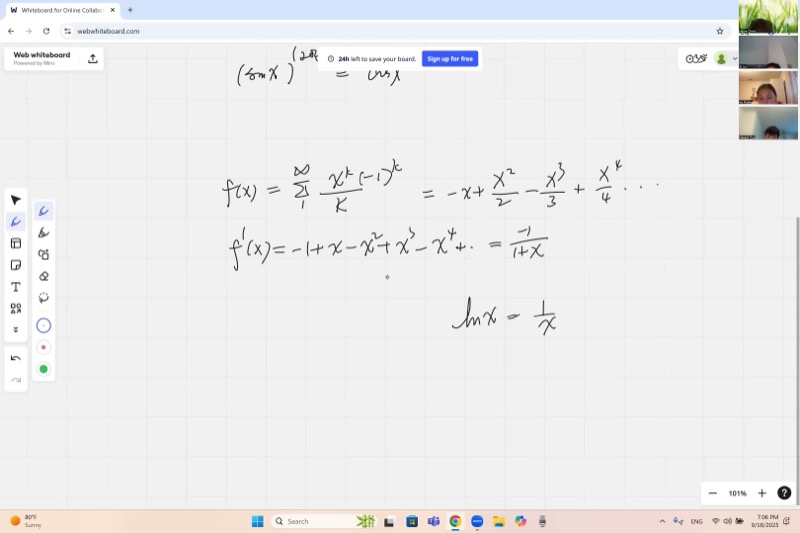
- Geometric series \(\frac{1}{1+x}\) as a power series
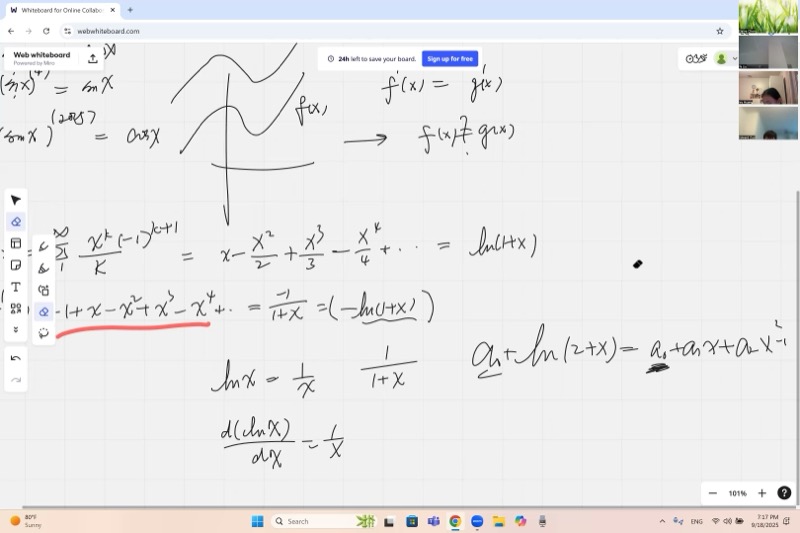
- Integrating a power series term by term to get \(\ln(1+x)\)
- Determining the integration constant by plugging in \(x = 0\)
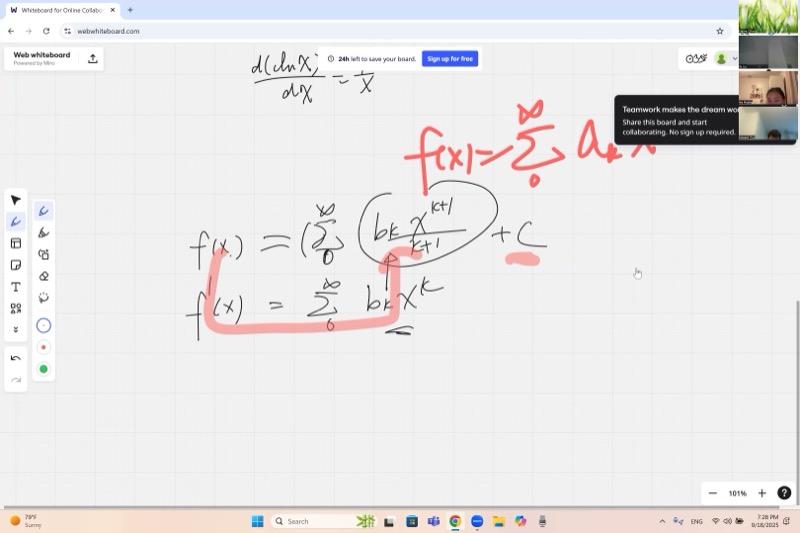
- Maclaurin coefficients: if \(f(x) = \sum a_k x^k\), then \(a_n = \frac{f^{(n)}(0)}{n!}\)
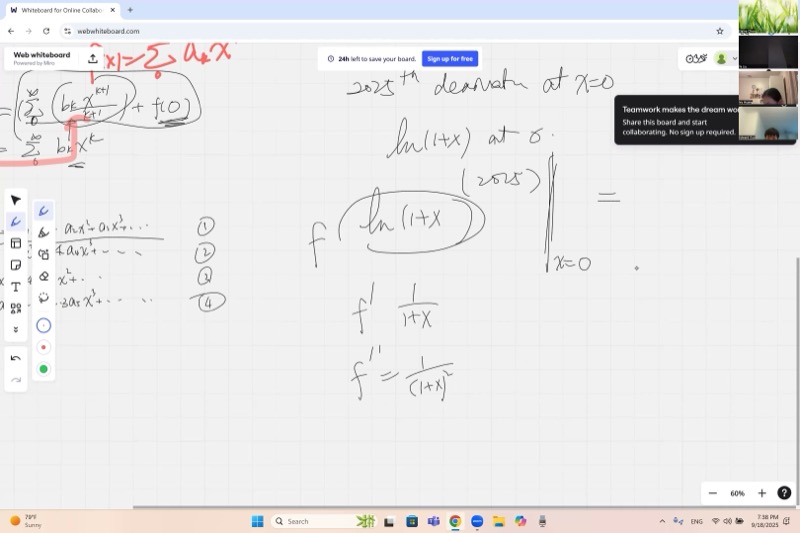
- Using Maclaurin expansions to find higher derivatives (e.g., the 2025th derivative of \(\ln(1+x)\) at \(x = 0\))
- Recognizing derivatives of known functions: \(f'(x) = -\frac{1}{1+x}\) matches the derivative of \(\ln(1+x)\)
Lecture Video
Key Frames from the Lecture
Prerequisites
Euler’s formula connects exponentials with trig functions using the imaginary number \(i\) (where \(i^2 = -1\)):
\[e^{i\theta} = \cos\theta + i\sin\theta\]
From this, we can extract \(\sin\) and \(\cos\) by looking at the power series of \(e^{i\theta}\) and separating the real and imaginary parts:
\[\cos\theta = 1 - \frac{\theta^2}{2!} + \frac{\theta^4}{4!} - \frac{\theta^6}{6!} + \cdots\]
\[\sin\theta = \theta - \frac{\theta^3}{3!} + \frac{\theta^5}{5!} - \frac{\theta^7}{7!} + \cdots\]
These power series are what let us differentiate \(\sin\) and \(\cos\) term by term!
A geometric series is a sum where each term is a fixed multiple of the previous one:
\[\sum_{k=0}^{\infty} r^k = 1 + r + r^2 + r^3 + \cdots = \frac{1}{1-r} \quad \text{(when } |r| < 1\text{)}\]
For example, with \(r = \frac{1}{2}\): \(1 + \frac{1}{2} + \frac{1}{4} + \frac{1}{8} + \cdots = 2\).
In this lesson we’ll use the substitution \(r = -x\) to get a series for \(\frac{1}{1+x}\).
A Maclaurin series expresses a function as an infinite polynomial centered at \(x = 0\):
\[f(x) = \sum_{n=0}^{\infty} \frac{f^{(n)}(0)}{n!} x^n = f(0) + f'(0)\,x + \frac{f''(0)}{2!}x^2 + \frac{f'''(0)}{3!}x^3 + \cdots\]
The key insight is that the coefficient of \(x^n\) equals \(\frac{f^{(n)}(0)}{n!}\). If you already know the power series, you can read off derivatives at zero without differentiating!
The natural logarithm \(\ln(x)\) is the inverse of \(e^x\). It answers: “what power of \(e\) gives \(x\)?”
Key facts:
- \(\ln(1) = 0\) because \(e^0 = 1\)
- \(\ln(e) = 1\) because \(e^1 = e\)
- \(\frac{d}{dx}\ln(x) = \frac{1}{x}\)
So \(\frac{d}{dx}\ln(1+x) = \frac{1}{1+x}\) by the chain rule.
Key Concepts
Derivatives of sin and cos from Euler’s Formula
Last time we saw the Maclaurin series for \(\sin x\) and \(\cos x\). By differentiating those series term by term, we can prove:
Differentiating the power series for sine and cosine term by term proves these two fundamental results. Notice the minus sign for cosine – it shows up because cosine decreases wherever sine is positive.
\[\boxed{\frac{d}{dx}(\sin x) = \cos x} \qquad \boxed{\frac{d}{dx}(\cos x) = -\sin x}\]
Why the minus sign for cosine? Differentiate the series for \(\cos x\):
\[\cos x = 1 - \frac{x^2}{2!} + \frac{x^4}{4!} - \frac{x^6}{6!} + \cdots\]
\[\frac{d}{dx}(\cos x) = 0 - \frac{2x}{2!} + \frac{4x^3}{4!} - \frac{6x^5}{6!} + \cdots = -x + \frac{x^3}{3!} - \frac{x^5}{5!} + \cdots\]
That’s exactly \(-\sin x\)!
Explore – see \(\sin x\), \(\cos x\), and their derivatives:
Drag the slider for \(a\). The dashed line shows the tangent to \(\sin x\) – its slope is always \(\cos(a)\), the height of the red curve!
The Derivative Cycle: Higher Derivatives of sin
A notable pattern emerges upon repeated differentiation of \(\sin x\):
| Derivative | Result |
|---|---|
| \(f(x) = \sin x\) | \(\sin x\) |
| \(f'(x)\) | \(\cos x\) |
| \(f''(x)\) | \(-\sin x\) |
| \(f'''(x)\) | \(-\cos x\) |
| \(f^{(4)}(x)\) | \(\sin x\) |
After 4 derivatives, we return to \(\sin x\). The cycle repeats indefinitely:
\[\sin x \;\to\; \cos x \;\to\; -\sin x \;\to\; -\cos x \;\to\; \sin x \;\to\; \cdots\]
To find the \(n\)th derivative, one divides \(n\) by 4 and examines the remainder:
| Remainder (\(n \bmod 4\)) | \(f^{(n)}(x)\) |
|---|---|
| 0 | \(\sin x\) |
| 1 | \(\cos x\) |
| 2 | \(-\sin x\) |
| 3 | \(-\cos x\) |
For example, the 100th derivative of \(\sin x\): \(100 \div 4 = 25\) remainder \(0\), so \(f^{(100)}(x) = \sin x\).
Interactive: Taylor Polynomial Approximations
Taylor Polynomials Building Up to the True Function
Watch successive Taylor polynomial terms appear, each improving the approximation.
Press Play to watch Taylor polynomials appear one by one. Each new term (dashed line) matches the blue curve over a wider range. Try switching between \(e^x\), \(\cos(x)\), and \(\sin(x)\).
Geometric Series as a Power Series
Recall the geometric series formula:
\[\frac{1}{1-r} = 1 + r + r^2 + r^3 + \cdots \quad \text{for } |r| < 1\]
Now substitute \(r = -x\):
\[\frac{1}{1+x} = 1 - x + x^2 - x^3 + x^4 - \cdots = \sum_{k=0}^{\infty} (-1)^k x^k\]
This is valid for \(|x| < 1\). We have expressed \(\frac{1}{1+x}\) as a power series.
Explore – see how partial sums of the series approximate \(\frac{1}{1+x}\):
Increase \(n\) with the slider and watch the red dashed curve match the blue curve better and better – but only for \(|x| < 1\)!
From Geometric Series to ln(1+x)
The key observation is that \(\frac{d}{dx}\ln(1+x) = \frac{1}{1+x}\). Therefore, if we integrate the geometric series term by term, we obtain \(\ln(1+x)\):
\[\int \frac{1}{1+x}\,dx = \int \left(1 - x + x^2 - x^3 + \cdots\right) dx\]
\[= C + x - \frac{x^2}{2} + \frac{x^3}{3} - \frac{x^4}{4} + \cdots\]
Determining the constant \(C\): substitute \(x = 0\):
\[\ln(1+0) = C + 0 - 0 + 0 - \cdots\] \[\ln(1) = C\] \[0 = C\]
So \(C = 0\), and we obtain:
By integrating the geometric series for \(\frac{1}{1+x}\) term by term, we turn the natural logarithm into an infinite polynomial. This series lets you compute logarithms using only addition, subtraction, and division.
\[\boxed{\ln(1+x) = x - \frac{x^2}{2} + \frac{x^3}{3} - \frac{x^4}{4} + \cdots = \sum_{k=1}^{\infty} \frac{(-1)^{k+1}\, x^k}{k}}\]
This is valid for \(-1 < x \le 1\).
Explore – see the power series for \(\ln(1+x)\) converge:
Increase \(n\) and watch the series (red dashed) hug the real \(\ln(1+x)\) curve (blue) more closely, especially between \(-1\) and \(1\).
Interactive: ln(1+x) Series — Partial Sums Converging
Partial Sums of ln(1+x) = x − x²/2 + x³/3 − ...
Watch partial sums accumulate term by term. Convergence occurs for |x| < 1.
Press Play to add terms one at a time. The red dashed curve (partial sum) converges to the blue ln(1+x) curve inside \(|x| < 1\). Try setting x outside this range to see divergence.
Recognizing Derivatives of Known Functions
Suppose someone gives you a function and tells you \(f'(x) = -\frac{1}{1+x}\). How do you find \(f(x)\)?
We recognize that:
\[\frac{d}{dx}\ln(1+x) = \frac{1}{1+x}\]
So \(-\frac{1}{1+x}\) is the derivative of \(-\ln(1+x)\). Therefore:
\[f(x) = -\ln(1+x) + C\]
This technique of “working backwards” from a derivative is a preview of integration.
Matching Maclaurin Coefficients
This is one of the most powerful techniques in the course. If a function has a Maclaurin series:
\[f(x) = a_0 + a_1 x + a_2 x^2 + a_3 x^3 + \cdots\]
then each coefficient is related to a derivative at zero:
If a function’s power series is known, one can immediately determine any derivative at \(x = 0\) without performing any differentiation. One reads off the coefficient and multiplies by \(n!\).
\[\boxed{a_n = \frac{f^{(n)}(0)}{n!}}\]
This means: if the power series is known, every derivative at \(x = 0\) is determined. Rearranging:
\[f^{(n)}(0) = n! \cdot a_n\]
Finding Crazy-High Derivatives Without Differentiating
As an illustration, suppose we seek the 2025th derivative of \(\ln(1+x)\) at \(x = 0\).
Differentiating \(\ln(1+x)\) two thousand and twenty-five times by hand is impractical. However, we know the power series:
\[\ln(1+x) = x - \frac{x^2}{2} + \frac{x^3}{3} - \frac{x^4}{4} + \cdots\]
The coefficient of \(x^n\) is \(a_n = \frac{(-1)^{n+1}}{n}\).
Using \(f^{(n)}(0) = n! \cdot a_n\):
\[f^{(2025)}(0) = 2025! \cdot \frac{(-1)^{2026}}{2025} = 2025! \cdot \frac{1}{2025} = \frac{2025!}{2025} = 2024!\]
Thus the 2025th derivative of \(\ln(1+x)\) at \(x = 0\) is \(2024!\) — obtained without differentiating even once.
Why does \((-1)^{2026} = 1\)? Because 2026 is even, and \((-1)^{\text{even}} = 1\).
As another example, the 4th derivative of \(\ln(1+x)\) at \(x = 0\):
\[f^{(4)}(0) = 4! \cdot \frac{(-1)^{5}}{4} = 24 \cdot \frac{-1}{4} = -6\]
One may verify this by differentiating \(\ln(1+x)\) four times directly — the result is the same.
Cheat Sheet
| What you want | Formula |
|---|---|
| Derivative of \(\sin x\) | \(\frac{d}{dx}(\sin x) = \cos x\) |
| Derivative of \(\cos x\) | \(\frac{d}{dx}(\cos x) = -\sin x\) |
| Derivative cycle of \(\sin\) | \(\sin \to \cos \to -\sin \to -\cos \to \sin\) (period 4) |
| Geometric series | \(\frac{1}{1+x} = \displaystyle\sum_{k=0}^{\infty} (-1)^k x^k = 1 - x + x^2 - x^3 + \cdots\) |
| Power series for \(\ln(1+x)\) | \(\ln(1+x) = \displaystyle\sum_{k=1}^{\infty} \frac{(-1)^{k+1} x^k}{k} = x - \frac{x^2}{2} + \frac{x^3}{3} - \cdots\) |
| Maclaurin coefficient formula | \(a_n = \frac{f^{(n)}(0)}{n!}\), so \(f^{(n)}(0) = n!\cdot a_n\) |
| Integration constant trick | Plug in \(x = 0\) after integrating to find \(C\) |
The Big Chain of Ideas
\[\frac{1}{1+x} \;\xrightarrow{\text{integrate}}\; \ln(1+x) \;\xrightarrow{\text{read off } a_n}\; \frac{(-1)^{n+1}}{n} \;\xrightarrow{\;n!\cdot a_n\;}\; f^{(n)}(0)\]