Derivatives of Trig Functions & sin(x)/x Limit
This lesson establishes the derivatives of the trigonometric functions \(\sin x\) and \(\cos x\) via three independent methods. We examine the fundamental limit \(\lim_{x \to 0} \frac{\sin x}{x} = 1\), which underlies these results, and explain why radians are the natural angle measure for calculus. These tools are essential for analyzing any periodic phenomenon.
Trigonometric functions model any phenomenon that repeats in a cycle:
- Acoustics: sound waves are sine and cosine curves — their derivatives describe the rate of change of air pressure.
- Mechanical design: the slope of a curved track at any point involves trigonometric derivatives.
- Oceanography: tidal levels follow sinusoidal patterns — the derivative indicates when the tide rises most rapidly.
- Electrical engineering: household AC current is a sine wave — circuit design requires its derivative.
The fact that the derivative of \(\sin x\) is \(\cos x\) is among the most frequently used results in science and engineering.
Topics Covered
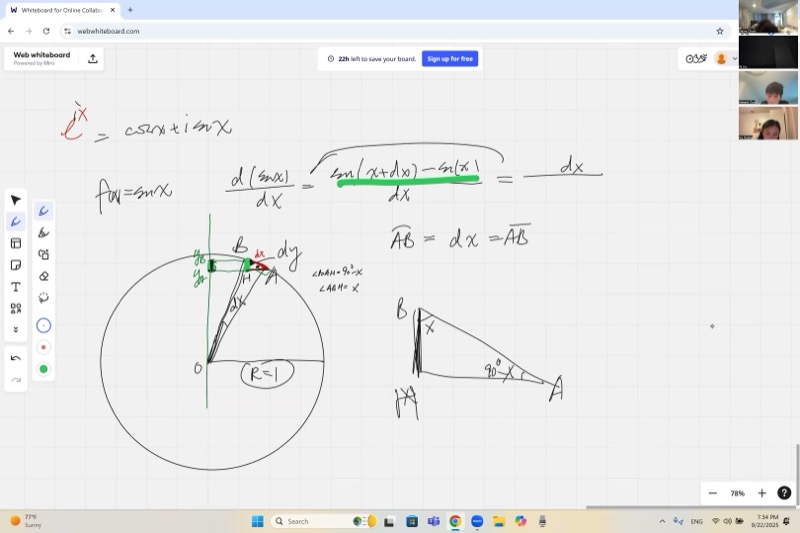
- Geometric derivation of \(\frac{d}{dx}(\sin x) = \cos x\) using the unit circle
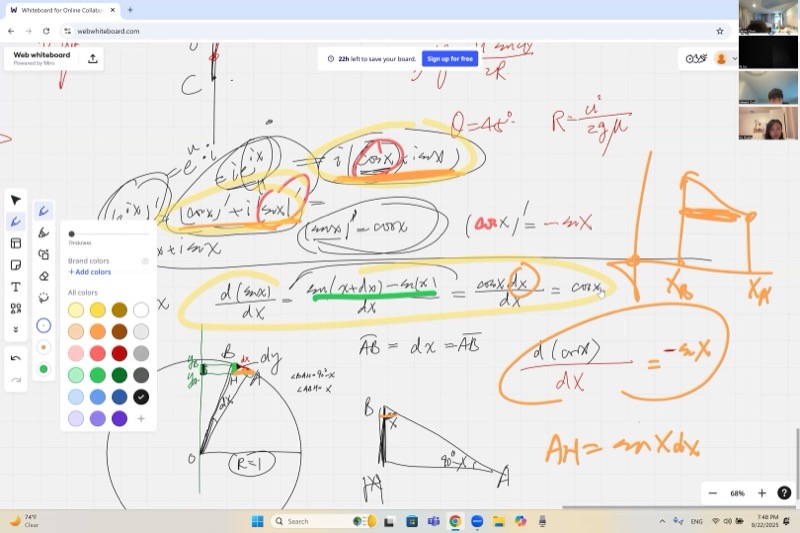
- Geometric derivation of \(\frac{d}{dx}(\cos x) = -\sin x\)
- Three approaches to trig derivatives: complex exponentials, geometry, and Maclaurin series
- The fundamental limit: \(\lim_{x \to 0} \frac{\sin x}{x} = 1\)
- Why radians matter (and what goes wrong with degrees)
- Significant figures and numerical estimation
- Maclaurin expansions of \(\sin x\) and \(\cos x\)
Lecture Video
Key Frames from the Lecture
Prerequisites
The unit circle is a circle centered at the origin with radius 1.
Any point on the unit circle can be written as \((\cos\theta, \sin\theta)\), where \(\theta\) is the angle measured counterclockwise from the positive \(x\)-axis.
- \(\cos\theta\) is the horizontal (x) coordinate
- \(\sin\theta\) is the vertical (y) coordinate
This is the bridge between angles and coordinates, and it’s the foundation for everything in this lesson.
A radian is a way to measure angles using the radius of a circle.
If you take the radius of a circle and wrap it along the edge (the arc), the angle you sweep out is 1 radian.
- A full circle = \(2\pi\) radians (about 6.28 radians)
- \(\pi\) radians = \(180°\)
- To convert: multiply degrees by \(\frac{\pi}{180}\)
Why radians matter for calculus: the identity \(\frac{d}{dx}(\sin x) = \cos x\) holds only when \(x\) is measured in radians.
The derivative of a function tells you its rate of change — how fast the output is changing as the input changes.
Geometrically, the derivative at a point is the slope of the tangent line at that point.
We write it as \(\frac{d}{dx} f(x)\) or \(f'(x)\).
A factorial is written \(n!\) and means “multiply all whole numbers from 1 to \(n\).”
- \(3! = 3 \times 2 \times 1 = 6\)
- \(5! = 5 \times 4 \times 3 \times 2 \times 1 = 120\)
- \(0! = 1\) (by definition)
Factorials grow incredibly fast and show up in series expansions.
Key Concepts
The derivative of \(\sin x\) is \(\cos x\). Geometrically, as an angle increases by an infinitesimal amount on the unit circle, the vertical coordinate (sine) changes at a rate equal to the horizontal coordinate (cosine).
\[\frac{d}{dx}(\sin x) = \cos x\]
Geometric Derivation: \(\frac{d}{dx}(\sin x) = \cos x\)
Consider a point moving around the unit circle. As the angle \(\theta\) increases by a small amount \(\Delta\theta\):
- The point moves along a tiny arc of length \(\Delta\theta\) (since radius = 1, arc length = angle in radians)
- For very small angles, the arc is practically a straight line segment — arc \(\approx\) chord
- This tiny displacement is tangent to the circle, pointing perpendicular to the radius
- The vertical component of this displacement (the change in \(\sin\theta\)) is \(\Delta\theta \cdot \cos\theta\)
So:
\[\frac{\Delta(\sin\theta)}{\Delta\theta} \approx \cos\theta\]
In the limit: \(\frac{d}{d\theta}(\sin\theta) = \cos\theta\)
Explore the unit circle — watch how \(\sin\theta\) changes as \(\theta\) moves:
The derivative of \(\cos x\) is \(-\sin x\). The negative sign makes sense: when \(\sin x\) is positive (point is above the x-axis), the horizontal coordinate (cosine) is decreasing, so its rate of change is negative.
\[\frac{d}{dx}(\cos x) = -\sin x\]
Geometric Derivation: \(\frac{d}{dx}(\cos x) = -\sin x\)
The same argument, but now we look at the horizontal component:
- As \(\theta\) increases by \(\Delta\theta\), the tiny displacement is tangent to the circle
- The horizontal component of this displacement is \(-\Delta\theta \cdot \sin\theta\) (negative because increasing \(\theta\) moves the point leftward in the upper half)
\[\frac{d}{d\theta}(\cos\theta) = -\sin\theta\]
When \(\theta\) is between \(0\) and \(\pi/2\), the point on the unit circle moves upward and to the left. Consequently, \(\sin\theta\) is increasing (positive derivative) while \(\cos\theta\) is decreasing (negative derivative). The factor \(-\sin\theta\) captures precisely this: cosine decreases wherever sine is positive.
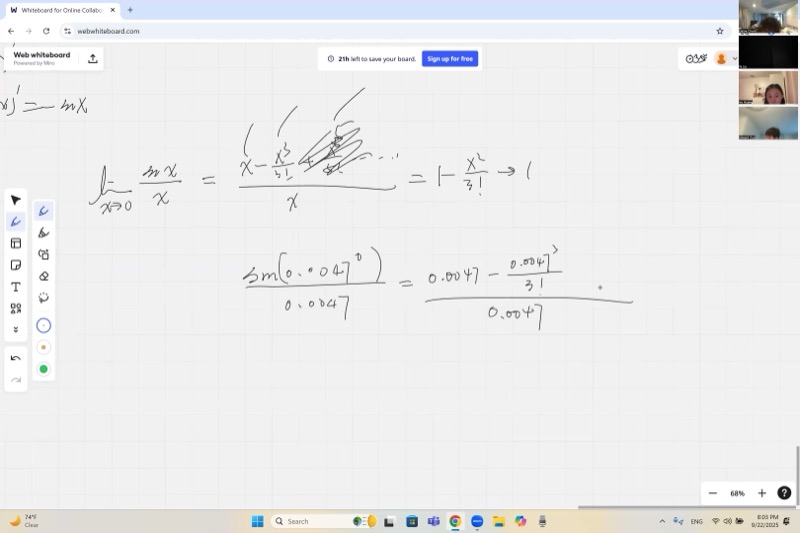
For small angles (in radians), \(\sin x\) is almost exactly equal to \(x\) itself. This fact is the hidden engine that makes the derivative of sine come out to cosine, and it only works when \(x\) is measured in radians.
\[\lim_{x \to 0} \frac{\sin x}{x} = 1\]
The Fundamental Limit: \(\lim_{x \to 0} \frac{\sin x}{x} = 1\)
This limit is the hidden engine behind \(\frac{d}{dx}(\sin x) = \cos x\).
Why is it true? Using the Maclaurin series:
\[\sin x = x - \frac{x^3}{3!} + \frac{x^5}{5!} - \cdots\]
Divide both sides by \(x\):
\[\frac{\sin x}{x} = 1 - \frac{x^2}{3!} + \frac{x^4}{5!} - \cdots\]
As \(x \to 0\), every term except the first vanishes, so \(\frac{\sin x}{x} \to 1\).
See it for yourself — zoom in near \(x = 0\):
Interactive: sin(x)/x Limit — Animated Zoom to x=0
sin(x)/x Approaching 1 as x → 0
Press Play to zoom into x = 0 and watch the function value converge to 1.
Press Play to zoom into x=0. As the window shrinks, sin(x)/x flattens to a constant value of exactly 1 – confirming the limit. The open circle at x=0 reminds us the function is technically undefined there.
Radians vs. Degrees: Why Radians Win
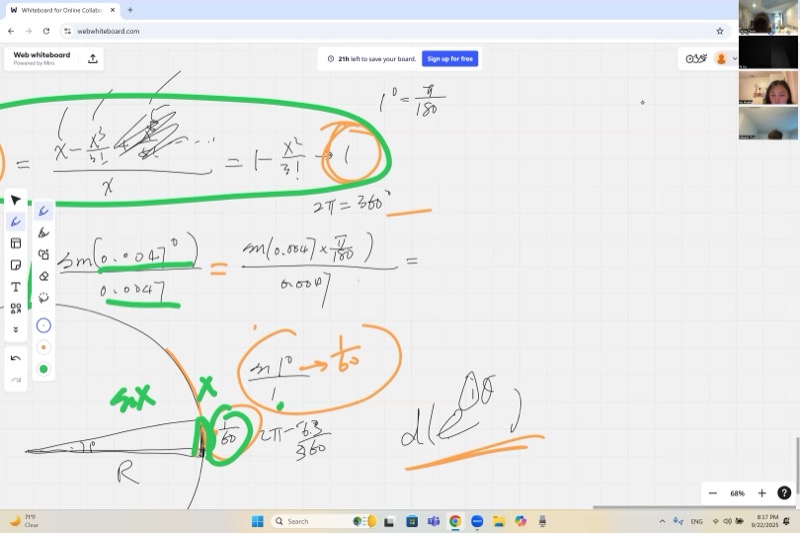
The limit \(\frac{\sin x}{x} \to 1\) only works when \(x\) is in radians.
If \(x\) is in degrees:
\[\lim_{x \to 0} \frac{\sin_{\text{deg}}(x)}{x} = \frac{\pi}{180} \approx 0.01745\]
If the angle is given in degrees, one must convert to radians:
\[0.0047° = 0.0047 \times \frac{\pi}{180} \approx 8.203 \times 10^{-5} \text{ radians}\]
Since \(\sin(\theta) \approx \theta\) for small \(\theta\) in radians:
\[\sin(0.0047°) \approx 8.203 \times 10^{-5}\]
So \(\frac{\sin(0.0047°)}{0.0047} \approx \frac{8.203 \times 10^{-5}}{0.0047} \approx 0.01745 = \frac{\pi}{180}\)
The answer is NOT 1 — it’s \(\frac{\pi}{180}\), because we divided by degrees, not radians.
Interactive: Unit Circle — Arc Length vs Chord Length
Arc vs Chord: Why sin(θ)/θ → 1
As θ shrinks, the arc (green) and chord (red) become nearly identical — their ratio approaches 1.
Press Play to watch the angle shrink. The green arc length equals \(\theta\), the blue dashed line is \(\sin\theta\), and the red chord connects the two points. As \(\theta \to 0\), all three lengths converge, proving \(\sin(\theta)/\theta \to 1\).
Three Roads to the Same Answer
There are three completely different ways to prove \(\frac{d}{dx}(\sin x) = \cos x\):
| Approach | Key idea |
|---|---|
| Complex exponential | Write \(\sin x = \frac{e^{ix} - e^{-ix}}{2i}\), differentiate using \(\frac{d}{dx}e^{ix} = ie^{ix}\) |
| Geometric (unit circle) | Arc \(\approx\) chord for small angles, project onto vertical axis |
| Maclaurin series | Differentiate \(x - \frac{x^3}{3!} + \frac{x^5}{5!} - \cdots\) term by term |
All three yield the same result — strong evidence of its correctness.
Maclaurin Series for Sine and Cosine
These infinite series let you compute trig functions using only addition and multiplication:
\[\sin x = x - \frac{x^3}{3!} + \frac{x^5}{5!} - \frac{x^7}{7!} + \cdots = \sum_{n=0}^{\infty} \frac{(-1)^n \, x^{2n+1}}{(2n+1)!}\]
\[\cos x = 1 - \frac{x^2}{2!} + \frac{x^4}{4!} - \frac{x^6}{6!} + \cdots = \sum_{n=0}^{\infty} \frac{(-1)^n \, x^{2n}}{(2n)!}\]
- \(\sin x\) contains only odd powers: \(x^1, x^3, x^5, \ldots\)
- \(\cos x\) contains only even powers: \(x^0, x^2, x^4, \ldots\)
- The signs alternate: \(+, -, +, -, \ldots\)
- Differentiating the \(\sin x\) series term by term yields exactly the \(\cos x\) series.
See how adding more terms gets closer to the true curve:
Significant Figures and Numerical Estimation
When working with very small angles:
- \(\sin x \approx x\) for small \(x\) (in radians) — the smaller \(x\) is, the better the approximation
- The number of significant figures you can trust depends on how small \(x\) is
- Always verify whether angles are in radians or degrees before computing.
Cheat Sheet
| Formula | Notes |
|---|---|
| \(\frac{d}{dx}(\sin x) = \cos x\) | \(x\) must be in radians |
| \(\frac{d}{dx}(\cos x) = -\sin x\) | Note the negative sign |
| \(\lim_{x \to 0} \frac{\sin x}{x} = 1\) | Only in radians |
| \(\lim_{x \to 0} \frac{\sin_{\text{deg}} x}{x} = \frac{\pi}{180}\) | In degrees |
| \(\sin x \approx x\) for small \(x\) | First-order approximation |
Maclaurin Series
\[\sin x = x - \frac{x^3}{3!} + \frac{x^5}{5!} - \cdots\]
\[\cos x = 1 - \frac{x^2}{2!} + \frac{x^4}{4!} - \cdots\]
Degrees to Radians
\[\theta_{\text{rad}} = \theta_{\text{deg}} \times \frac{\pi}{180}\]