Derivatives of tan & sec — Graphical and Algebraic
This lesson derives the derivatives of tangent and secant — two trigonometric functions that exhibit unbounded growth near their vertical asymptotes. We establish these results through three independent methods: algebraic computation via the quotient rule, geometric reasoning on the unit circle, and complex exponential techniques. All three approaches yield the same formulas.
The tangent and secant functions arise in contexts involving slopes and angular dependence:
- Navigation: GPS systems use tangent functions to convert between angles and distances — their derivatives enable real-time course corrections.
- Architecture: the slope of a roof is a tangent ratio — the derivative quantifies the sensitivity of the slope to changes in angle.
- Optics: lenses bend light at angles described by tangent — understanding how rapidly that angle changes is essential to camera and telescope design.
- Mechanical engineering: at steep track sections, the tangent grows rapidly — its derivative (\(\sec^2\)) quantifies how fast the slope is increasing.
Given the derivatives of sine and cosine, the derivatives of tangent and secant follow — and we establish them by three distinct methods.
Topics Covered
- Derivative of \(\tan\theta = \sec^2\theta\) via the quotient rule
- Graphical differentiation of trig functions on the unit circle (arc \(\approx\) chord for small angles)
- Derivative of \(\sec\theta = \sec\theta\cdot\tan\theta\) via similar triangles
- Complex exponential approach: writing \(\tan\theta\) in terms of \(e^{i\theta}\)
- Long division and simplification of complex exponential expressions
- Power expansion for differentials: plugging in \(\theta + d\theta\) and keeping first-order infinitesimals
Lecture Video
Key Frames from the Lecture
Prerequisites
Tangent is the ratio of sine to cosine:
\[\tan\theta = \frac{\sin\theta}{\cos\theta}\]
Secant is the reciprocal of cosine:
\[\sec\theta = \frac{1}{\cos\theta}\]
On the unit circle, \(\tan\theta\) is the length of the vertical segment from the x-axis to where the radius line hits the vertical tangent line at \((1, 0)\). Secant is the distance from the origin to that same intersection point.
The quotient rule tells you how to differentiate a fraction of two functions:
\[\frac{d}{dx}\left(\frac{f(x)}{g(x)}\right) = \frac{f'(x)\,g(x) - f(x)\,g'(x)}{[g(x)]^2}\]
A handy mnemonic: “low d-high minus high d-low, over the square of what’s below.”
We already know \(\frac{d}{dx}(\sin x) = \cos x\) and \(\frac{d}{dx}(\cos x) = -\sin x\), so we have everything we need to differentiate \(\frac{\sin x}{\cos x}\).
Using Euler’s formula \(e^{i\theta} = \cos\theta + i\sin\theta\), we can write sine and cosine as:
\[\sin\theta = \frac{e^{i\theta} - e^{-i\theta}}{2i}, \qquad \cos\theta = \frac{e^{i\theta} + e^{-i\theta}}{2}\]
This means we can also write tangent as a ratio of exponentials:
\[\tan\theta = \frac{e^{i\theta} - e^{-i\theta}}{i(e^{i\theta} + e^{-i\theta})}\]
Complex exponentials are powerful because the derivative of \(e^{i\theta}\) is simply \(ie^{i\theta}\) — no sign-flipping to remember!
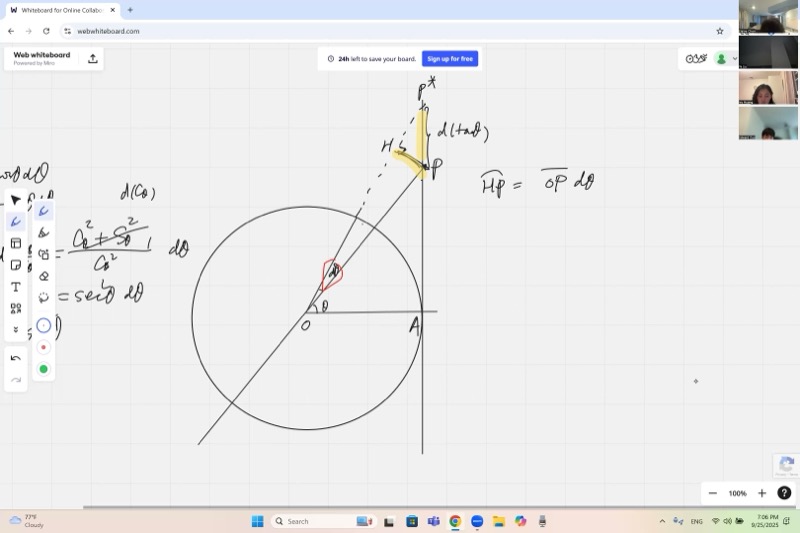
When a point moves along the unit circle by a tiny angle \(d\theta\), it traces out a small arc of length \(d\theta\).
For very small angles, that curved arc is practically indistinguishable from the straight-line chord connecting the two endpoints. This is the key geometric idea:
\[\text{arc} \approx \text{chord} \quad \text{when } d\theta \text{ is small}\]
This approximation is what makes geometric proofs of trig derivatives work.
Two triangles are similar if they have the same angles (same shape, possibly different size). When triangles are similar, the ratios of corresponding sides are equal:
\[\frac{a_1}{a_2} = \frac{b_1}{b_2} = \frac{c_1}{c_2}\]
In this lesson, we use similar triangles that appear on the unit circle when we nudge an angle by \(d\theta\). The tiny triangle formed by the infinitesimal change is similar to the big triangle formed by the secant and tangent lines.
Key Concepts
Derivative of \(\tan\theta\) via the Quotient Rule
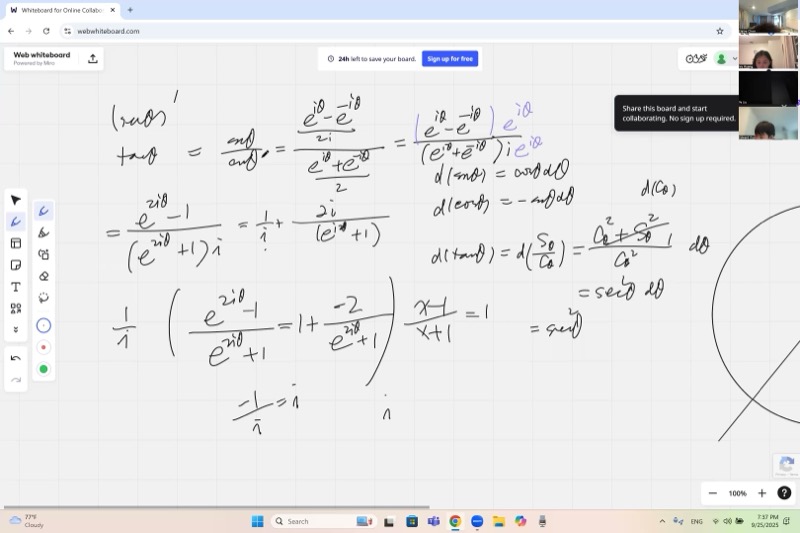
Since \(\tan\theta = \frac{\sin\theta}{\cos\theta}\), we apply the quotient rule with \(f(\theta) = \sin\theta\) and \(g(\theta) = \cos\theta\):
\[\frac{d}{d\theta}(\tan\theta) = \frac{\cos\theta \cdot \cos\theta - \sin\theta \cdot (-\sin\theta)}{\cos^2\theta}\]
\[= \frac{\cos^2\theta + \sin^2\theta}{\cos^2\theta} = \frac{1}{\cos^2\theta}\]
The derivative of tangent is secant squared. This follows from the quotient rule on sin/cos, with the Pythagorean identity doing all the heavy lifting to simplify the numerator to 1.
\[\boxed{\frac{d}{d\theta}(\tan\theta) = \sec^2\theta}\]
Explore – see \(\tan\theta\) and its derivative \(\sec^2\theta\):
Drag the slider for \(a\). The green dashed line is tangent to \(\tan x\) (blue), and its slope always equals \(\sec^2(a)\) (red dashed curve). Observe that the slope is always at least 1 — \(\tan x\) is always increasing.
Animated visualization – tangent line sliding along \(\tan(x)\) with slope \(= \sec^2(x)\):
Graphical Derivation on the Unit Circle
Instead of algebra, we can derive \(\frac{d}{d\theta}(\tan\theta) = \sec^2\theta\) using a picture.
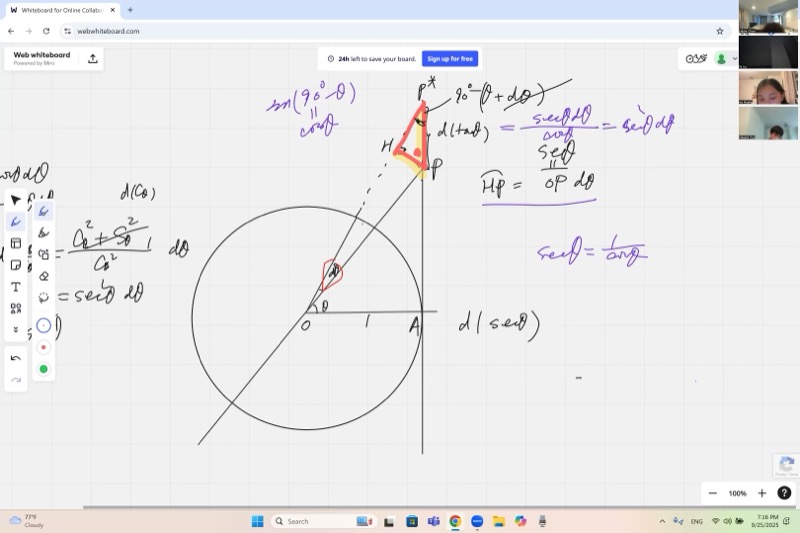
On the unit circle, draw the radius at angle \(\theta\) and extend it until it hits the vertical tangent line at \(x = 1\). The vertical intercept on that line has height \(\tan\theta\), and the distance from the origin to the intercept point is \(\sec\theta\).
Now nudge \(\theta\) by a tiny amount \(d\theta\):
- The radius rotates by \(d\theta\), sweeping the intercept point upward along the tangent line
- The tiny triangle formed at the intercept point is similar to the big triangle with sides \(1\), \(\tan\theta\), and \(\sec\theta\)
- The small displacement along the tangent line is \(\sec^2\theta \cdot d\theta\)
- This displacement equals \(d(\tan\theta)\)
So \(\frac{d(\tan\theta)}{d\theta} = \sec^2\theta\) — the same answer, straight from the geometry!
Explore – see the unit circle construction for \(\tan\theta\) and \(\sec\theta\):
Drag \(\theta\) and observe the tangent height (red segment) and the secant length (purple label). Note the rapid growth of \(\tan\theta\) as \(\theta\) approaches \(\pm\frac{\pi}{2}\).
Animated visualization – \(\sec(x)\) and its derivative \(\sec(x)\tan(x)\) with a sliding marker:
Derivative of \(\sec\theta\) via Similar Triangles
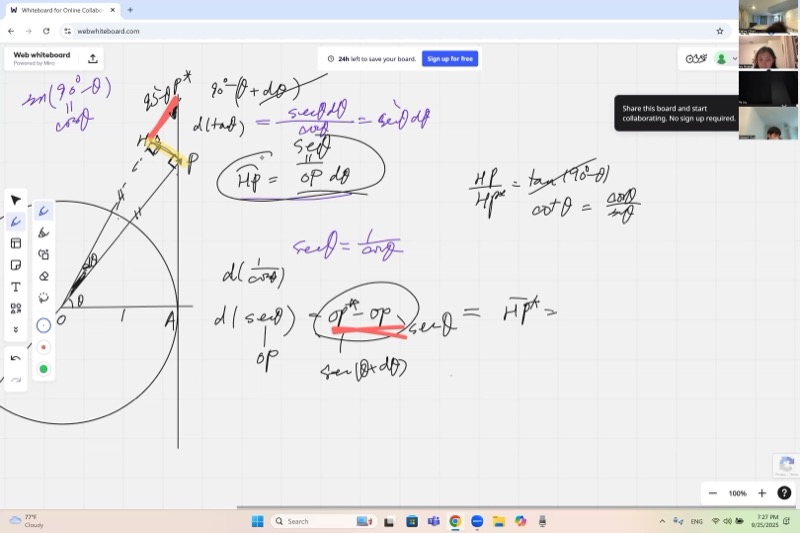
We seek \(\frac{d}{d\theta}(\sec\theta)\). Using the same unit circle construction:
\(\sec\theta\) is the distance from the origin to the point \((1, \tan\theta)\) on the vertical tangent line.
When \(\theta\) increases by \(d\theta\), the intercept point moves along the tangent line. The tiny triangle formed is similar to the original right triangle with legs \(1\) and \(\tan\theta\) and hypotenuse \(\sec\theta\).
By similar triangles, the change in the hypotenuse (which is \(d(\sec\theta)\)) satisfies:
\[\frac{d(\sec\theta)}{\sec\theta \cdot d\theta} = \frac{\sec\theta}{1} \cdot \frac{\tan\theta}{\sec\theta}\]
Working this out:
\[d(\sec\theta) = \sec\theta \cdot \tan\theta \cdot d\theta\]
The derivative of secant is secant times tangent. You can prove this geometrically using similar triangles on the unit circle, or algebraically using the chain rule on \((\cos\theta)^{-1}\).
\[\boxed{\frac{d}{d\theta}(\sec\theta) = \sec\theta \cdot \tan\theta}\]
We can verify this using the chain rule on \(\sec\theta = (\cos\theta)^{-1}\):
\[\frac{d}{d\theta}(\cos\theta)^{-1} = -1 \cdot (\cos\theta)^{-2} \cdot (-\sin\theta) = \frac{\sin\theta}{\cos^2\theta} = \frac{1}{\cos\theta} \cdot \frac{\sin\theta}{\cos\theta} = \sec\theta \cdot \tan\theta \;\checkmark\]
Complex Exponential Approach to \(\frac{d}{d\theta}(\tan\theta)\)
An alternative algebraic method proceeds by expressing tangent via Euler’s formula:
\[\tan\theta = \frac{e^{i\theta} - e^{-i\theta}}{i(e^{i\theta} + e^{-i\theta})}\]
To differentiate, we can use the quotient rule on this expression. Let \(u = e^{i\theta} - e^{-i\theta}\) and \(v = i(e^{i\theta} + e^{-i\theta})\). Then:
\[u' = ie^{i\theta} + ie^{-i\theta} = i(e^{i\theta} + e^{-i\theta})\]
\[v' = i(ie^{i\theta} - ie^{-i\theta}) = i^2(e^{i\theta} - e^{-i\theta}) = -(e^{i\theta} - e^{-i\theta})\]
By the quotient rule:
\[\frac{d}{d\theta}(\tan\theta) = \frac{u'v - uv'}{v^2}\]
\[= \frac{i(e^{i\theta}+e^{-i\theta}) \cdot i(e^{i\theta}+e^{-i\theta}) - (e^{i\theta}-e^{-i\theta}) \cdot [-(e^{i\theta}-e^{-i\theta})]}{[i(e^{i\theta}+e^{-i\theta})]^2}\]
The numerator becomes:
\[i^2(e^{i\theta}+e^{-i\theta})^2 + (e^{i\theta}-e^{-i\theta})^2\]
\[= -(e^{i\theta}+e^{-i\theta})^2 + (e^{i\theta}-e^{-i\theta})^2\]
Expanding both squares:
\[= -(e^{2i\theta} + 2 + e^{-2i\theta}) + (e^{2i\theta} - 2 + e^{-2i\theta}) = -4\]
The denominator is:
\[-\left(e^{i\theta}+e^{-i\theta}\right)^2 = -(2\cos\theta)^2 = -4\cos^2\theta\]
So:
\[\frac{d}{d\theta}(\tan\theta) = \frac{-4}{-4\cos^2\theta} = \frac{1}{\cos^2\theta} = \sec^2\theta \;\checkmark\]
Three completely different methods — quotient rule, geometry, and complex exponentials — all give \(\sec^2\theta\).
Long Division with Complex Exponentials
When working with expressions like \(\frac{e^{i\theta} - e^{-i\theta}}{e^{i\theta} + e^{-i\theta}}\), you can simplify by dividing numerator and denominator by \(e^{-i\theta}\):
\[\frac{e^{i\theta} - e^{-i\theta}}{e^{i\theta} + e^{-i\theta}} = \frac{e^{2i\theta} - 1}{e^{2i\theta} + 1}\]
One may also let \(w = e^{i\theta}\) to convert everything into a clean polynomial-style fraction:
\[\tan\theta = \frac{w^2 - 1}{i(w^2 + 1)} \quad \text{where } w = e^{i\theta}\]
This substitution simplifies the quotient rule computation and reduces the likelihood of errors. The key technique is choosing a good substitution to simplify the algebra before differentiating.
Power Expansion for Differentials
Another approach is to substitute \(\theta + d\theta\) directly into the function and retain only first-order terms (discarding anything with \((d\theta)^2\) or higher):
For \(\tan(\theta + d\theta)\), recall that:
\[e^{i(\theta+d\theta)} = e^{i\theta} \cdot e^{i\,d\theta} \approx e^{i\theta}(1 + i\,d\theta)\]
since \(e^{i\,d\theta} \approx 1 + i\,d\theta\) when \(d\theta\) is infinitesimally small. Substituting into the tangent formula:
\[\tan(\theta + d\theta) \approx \frac{e^{i\theta}(1+i\,d\theta) - e^{-i\theta}(1-i\,d\theta)}{i\left[e^{i\theta}(1+i\,d\theta) + e^{-i\theta}(1-i\,d\theta)\right]}\]
Expanding the numerator:
\[(e^{i\theta} - e^{-i\theta}) + i\,d\theta\,(e^{i\theta} + e^{-i\theta})\]
Expanding the denominator:
\[i\left[(e^{i\theta} + e^{-i\theta}) + i\,d\theta\,(e^{i\theta} - e^{-i\theta})\right]\]
After careful algebra (dividing and discarding second-order terms), the result is:
\[\tan(\theta + d\theta) - \tan\theta = \sec^2\theta \cdot d\theta\]
This “infinitesimal substitution” method is quite explicit: one sees exactly where each component of the derivative originates.
An infinitesimal \(d\theta\) is regarded as so small that its square is negligible. More precisely, when one takes the limit as \(d\theta \to 0\) in \(\frac{\Delta f}{d\theta}\), any term with \((d\theta)^2\) in the numerator contributes \(0\) after division by \(d\theta\). Therefore, only first-order terms need to be retained — all higher-order terms vanish.
Explore – compare \(\tan(x)\) with its linear approximation at a point:
Drag \(a\) and see how the orange tangent line (slope \(= \sec^2 a\)) hugs the blue curve near the point. The green dashed curves are \(\pm\sec x\) — they form the “envelope” that \(\tan x\) bounces between.
Cheat Sheet
| Formula | How to remember it |
|---|---|
| \(\dfrac{d}{d\theta}(\tan\theta) = \sec^2\theta\) | Quotient rule on \(\frac{\sin}{\cos}\), then Pythagorean identity |
| \(\dfrac{d}{d\theta}(\sec\theta) = \sec\theta\cdot\tan\theta\) | Chain rule on \((\cos\theta)^{-1}\), or similar triangles |
| \(\tan\theta = \dfrac{\sin\theta}{\cos\theta}\) | SOH/CAH: opposite over adjacent |
| \(\sec\theta = \dfrac{1}{\cos\theta}\) | “Secant” = reciprocal of cosine |
| \(\sin^2\theta + \cos^2\theta = 1\) | The Pythagorean identity — the engine behind \(\sec^2\theta\) |
| \(1 + \tan^2\theta = \sec^2\theta\) | Divide the Pythagorean identity by \(\cos^2\theta\) |
Complex Exponential Forms
\[\tan\theta = \frac{e^{i\theta} - e^{-i\theta}}{i(e^{i\theta} + e^{-i\theta})}\]
All Six Trig Derivatives (So Far)
\[\frac{d}{d\theta}(\sin\theta) = \cos\theta \qquad \frac{d}{d\theta}(\cos\theta) = -\sin\theta\]
\[\frac{d}{d\theta}(\tan\theta) = \sec^2\theta \qquad \frac{d}{d\theta}(\sec\theta) = \sec\theta\tan\theta\]
The Infinitesimal Trick
To find the derivative of \(f(\theta)\):
- Compute \(f(\theta + d\theta)\) using \(e^{i\,d\theta} \approx 1 + i\,d\theta\)
- Subtract \(f(\theta)\)
- Keep only terms with one factor of \(d\theta\)
- Divide by \(d\theta\) — the result is the derivative.