Limits Involving the Definition of e, Power Expansions & Higher Derivatives of Inverse Functions
The number \(e\) arises naturally in a wide range of mathematical contexts. This lesson examines limits involving expressions of the form \((1 + \text{small quantity})^{\text{large exponent}}\) and develops a logarithmic technique for evaluating them. We also establish that the Maclaurin coefficients of a power series encode all derivatives of the function at zero, enabling one to determine, for example, the 2024th derivative without performing any differentiation.
The number \(e\) and the techniques for evaluating limits of this type appear frequently in science and applied mathematics:
- Finance: compound interest formulas use \((1 + r/n)^n\), which approaches \(e^r\) – this is exactly how banks calculate continuously compounded interest
- Medicine: drug concentration in the bloodstream decays exponentially, and doctors use limits involving \(e\) to determine dosing schedules
- Engineering: electrical circuits with capacitors charge and discharge following \(e\)-based exponential curves, and engineers approximate these with power expansions
- Computer science: algorithms that divide problems in half have logarithmic complexity – understanding \(\ln(1+x)\) expansions helps analyze their performance
- Physics: radioactive decay, heat transfer, and population dynamics all rely on exponential functions built from the definition of \(e\)
This lesson develops techniques for evaluating limits that disguise the definition of \(e\), examines when power expansion applies (and when it does not), and demonstrates how Maclaurin series allow one to determine high-order derivatives without explicit differentiation.
Topics Covered
- The definition of \(e\): \(\displaystyle\lim_{n \to \infty}\left(1 + \frac{1}{n}\right)^n = e\)
- Variations of the limit definition: \(\displaystyle\lim_{n \to \infty}\left(1 - \frac{x}{n}\right)^n = e^{-x}\)
- Evaluating limits like \(\displaystyle\lim_{n \to \infty}\left(1 - \frac{3}{n^2}\right)^n\) using the logarithm technique
- Re-deriving the power expansion of \(\ln(1+x)\) from first principles
- Using \(\ln(1+x)\) expansions to handle limits where direct binomial expansion fails
- Why binomial expansion of \((1 + 1/n)^n\) does not converge via truncation in powers of \(n\)
- The Maclaurin coefficient formula: \(f^{(k)}(0) = k! \cdot a_k\)
- Odd and even functions and their implications for Maclaurin expansions
- Finding higher derivatives of \(\arcsin x\) using power series
Lecture Video
Key Frames from the Lecture
Prerequisites
The number \(e \approx 2.71828\ldots\) is one of the most important constants in mathematics. It is defined as:
\[e = \lim_{n \to \infty}\left(1 + \frac{1}{n}\right)^n\]
As \(n\) grows, the base \(1 + 1/n\) approaches 1, while the exponent \(n\) grows without bound. These two opposing tendencies balance to produce the finite number \(e\). This is a \(1^\infty\) indeterminate form – the result may be 1, infinity, or any finite value, depending on how the base and exponent interact.
We proved in a previous lesson that:
\[\ln(1+x) = x - \frac{x^2}{2} + \frac{x^3}{3} - \frac{x^4}{4} + \cdots = \sum_{k=1}^{\infty} \frac{(-1)^{k+1} x^k}{k}\]
This comes from integrating the geometric series \(\frac{1}{1+x} = 1 - x + x^2 - x^3 + \cdots\) term by term. The constant of integration is determined by substituting \(x = 0\) (since \(\ln 1 = 0\)).
The binomial expansion generalizes \((1+x)^n\) for any exponent \(n\), even negative or fractional:
\[(1+x)^n = \sum_{k=0}^{\infty} \binom{n}{k} x^k = 1 + nx + \frac{n(n-1)}{2!}x^2 + \frac{n(n-1)(n-2)}{3!}x^3 + \cdots\]
When \(n\) is a negative integer like \(-1\), this gives us the geometric series:
\[(1+x)^{-1} = 1 - x + x^2 - x^3 + \cdots\]
An even function satisfies \(f(-x) = f(x)\) – its graph is symmetric about the \(y\)-axis. Examples: \(x^2\), \(\cos x\).
An odd function satisfies \(f(-x) = -f(x)\) – its graph has rotational symmetry about the origin. Examples: \(x^3\), \(\sin x\).
In terms of Maclaurin series:
- Even functions have only even powers of \(x\)
- Odd functions have only odd powers of \(x\)
This means that for an odd function, all even-order derivatives at zero are automatically zero.
If a function has a Maclaurin expansion \(f(x) = \sum_{k=0}^{\infty} a_k x^k\), then each coefficient encodes a derivative:
\[a_k = \frac{f^{(k)}(0)}{k!} \quad \Longleftrightarrow \quad f^{(k)}(0) = k! \cdot a_k\]
Thus, if one knows the power series, any derivative at zero can be read off without differentiating.
Key Concepts
Variations on the Definition of e
We start from the fundamental definition:
\[\lim_{n \to \infty}\left(1 + \frac{1}{n}\right)^n = e\]
The key feature is that the term added to 1 inside the parentheses is the reciprocal of the exponent. We can create variations by forcing other expressions into this same shape.
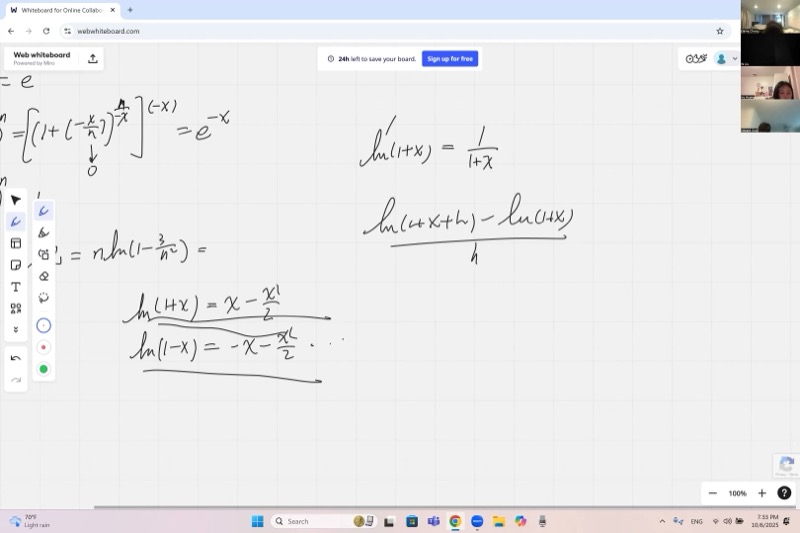
Example 1: Find \(\displaystyle\lim_{n \to \infty}\left(1 - \frac{x}{n}\right)^n\).
We rewrite the expression to match the definition. Since we have \(-x/n\) inside and \(n\) as the exponent, we can write:
\[\left(1 + \frac{(-x)}{n}\right)^n\]
To force this into the \(e\)-definition form, we need the exponent to be the reciprocal of \(-x/n\), which is \(-n/x\). So we write:
\[\left(1 + \frac{(-x)}{n}\right)^{(-n/x) \cdot (-x)} = \left[\left(1 + \frac{(-x)}{n}\right)^{-n/x}\right]^{-x}\]
As \(n \to \infty\), the inner bracket approaches \(e\) by definition, so the limit is:
Any limit of the form \((1 + \text{something}/n)^n\) can be reshaped into the definition of \(e\). The key step is to rewrite the expression so the exponent is the reciprocal of the small term inside the parentheses.
\[\boxed{\lim_{n \to \infty}\left(1 - \frac{x}{n}\right)^n = e^{-x}}\]
Interactive demonstration – convergence of \((1 + 1/n)^n\) to \(e\):
Drag the slider for \(n\) and watch the green dot approach the dashed red line \(y = e \approx 2.718\).
Animated visualization – \((1 + x/n)^n\) converging to \(e^x\) as \(n\) grows:
The Logarithm Technique for Limits
Example 2: Find \(\displaystyle\lim_{n \to \infty}\left(1 - \frac{3}{n^2}\right)^n\).
This one cannot be directly forced into the \(e\)-definition because the term inside is \(-3/n^2\) while the exponent is only \(n\) (not \(n^2\)). Let’s call the limit \(L\) and take the natural log:
\[\ln L = \lim_{n \to \infty} n \cdot \ln\left(1 - \frac{3}{n^2}\right)\]
Now we apply the Maclaurin expansion \(\ln(1+u) = u - \frac{u^2}{2} + \cdots\) with \(u = -3/n^2\):
\[\ln\left(1 - \frac{3}{n^2}\right) = -\frac{3}{n^2} - \frac{9}{2n^4} - \cdots\]
Multiplying by \(n\):
\[n \cdot \ln\left(1 - \frac{3}{n^2}\right) = -\frac{3}{n} - \frac{9}{2n^3} - \cdots\]
As \(n \to \infty\), every term vanishes. So \(\ln L = 0\), which means:
\[\boxed{L = e^0 = 1}\]
One may verify that this is consistent with intuition: the base \(1 - 3/n^2\) approaches 1 faster than the exponent \(n\) grows, so the limit reduces to 1.
Alternative approach: Force it into the \(e\)-definition directly. Rewrite as:
\[\left(1 + \frac{(-3)}{n^2}\right)^{(-n^2/3) \cdot (-3/n)} = \left[\left(1 + \frac{(-3)}{n^2}\right)^{-n^2/3}\right]^{-3/n}\]
The inner bracket approaches \(e\), and the outer exponent \(-3/n \to 0\). So we get \(e^0 = 1\). Same answer, confirmed.
A Tricky Product Limit
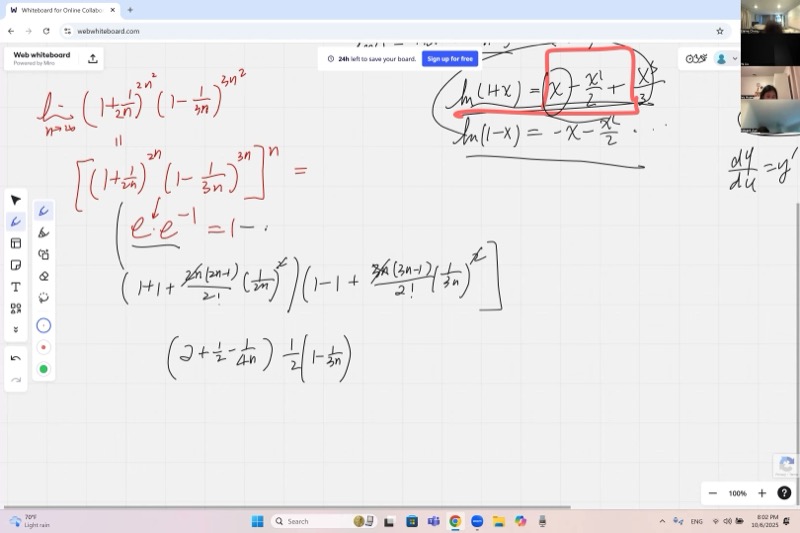
Example 3: Find \(\displaystyle\lim_{n \to \infty}\left(1 + \frac{1}{2n}\right)^{2n^2}\left(1 - \frac{1}{3n}\right)^{3n^2}\).
This is a product of two terms, each in the \(1^\infty\) indeterminate form. A natural first approach is to force each into the \(e\)-definition:
\[\left(1 + \frac{1}{2n}\right)^{2n} \to e \quad \text{and} \quad \left(1 - \frac{1}{3n}\right)^{3n} \to e^{-1}\]
But the actual exponents are \(2n^2\) and \(3n^2\), not \(2n\) and \(3n\). We can rewrite the first factor as:
\[\left[\left(1 + \frac{1}{2n}\right)^{2n}\right]^{n} \to e^n \to \infty\]
and the second as:
\[\left[\left(1 - \frac{1}{3n}\right)^{3n}\right]^{n} \to e^{-n} \to 0\]
So we get \(\infty \cdot 0\), an indeterminate form. We need a more careful approach.
Why binomial expansion fails here: If you try to expand \((1 + 1/(2n))^{2n^2}\) using the binomial theorem, the coefficients \(\binom{2n^2}{k}\) contain powers of \(n\) in the numerator that cancel with the powers of \(1/(2n)\) in the denominator. The terms do not shrink based on powers of \(1/n\) – they shrink based on \(1/k!\). This means you cannot truncate to a few terms; you need infinitely many to capture the limit.
The logarithm technique works: Set \(L\) equal to the limit and take the log:
\[\ln L = \lim_{n \to \infty}\left[2n^2 \ln\left(1 + \frac{1}{2n}\right) + 3n^2 \ln\left(1 - \frac{1}{3n}\right)\right]\]
Now expand each logarithm using \(\ln(1+u) = u - \frac{u^2}{2} + \frac{u^3}{3} - \cdots\):
\[\ln\left(1 + \frac{1}{2n}\right) = \frac{1}{2n} - \frac{1}{8n^2} + \cdots\]
\[\ln\left(1 - \frac{1}{3n}\right) = -\frac{1}{3n} - \frac{1}{18n^2} - \cdots\]
Multiplying through:
\[2n^2 \cdot \ln\left(1 + \frac{1}{2n}\right) = 2n^2\left(\frac{1}{2n} - \frac{1}{8n^2} + \cdots\right) = n - \frac{1}{4} + \cdots\]
\[3n^2 \cdot \ln\left(1 - \frac{1}{3n}\right) = 3n^2\left(-\frac{1}{3n} - \frac{1}{18n^2} - \cdots\right) = -n - \frac{1}{6} + \cdots\]
Adding them together:
\[\ln L = \left(n - \frac{1}{4} + \cdots\right) + \left(-n - \frac{1}{6} + \cdots\right) = -\frac{1}{4} - \frac{1}{6} + \cdots = -\frac{5}{12}\]
The \(n\) terms cancel (as expected), and the higher-order terms vanish. Therefore:
\[\boxed{L = e^{-5/12}}\]
This is a notable result – a value between 0 and 1 that cannot be determined without the technique.
Interactive demonstration – convergence of the product as \(n\) grows:
Increase \(n\) with the slider and watch the green dot converge to \(e^{-5/12} \approx 0.659\).
Why the Logarithm Technique is Essential
The key insight from the product limit example is this: when you have \((1 + \text{small})^{\text{large}}\) and try to expand directly with the binomial theorem, the convergence depends on \(1/k!\) (the factorial in the denominator), not on powers of \(1/n\). This means:
- You cannot truncate the expansion at a few terms
- The “lowest order infinitesimal” strategy does not apply directly
But when you take the natural log, the exponent comes down as a multiplier:
\[\ln\left[(1 + u)^m\right] = m \cdot \ln(1+u)\]
Now the expansion of \(\ln(1+u)\) does depend on increasing powers of \(u\), so truncation works perfectly. This is why the logarithm technique is so powerful for these limit problems.
Re-deriving the Power Expansion of ln(1+x)
This derivation was reviewed in the lecture from scratch. Here is the chain of reasoning:
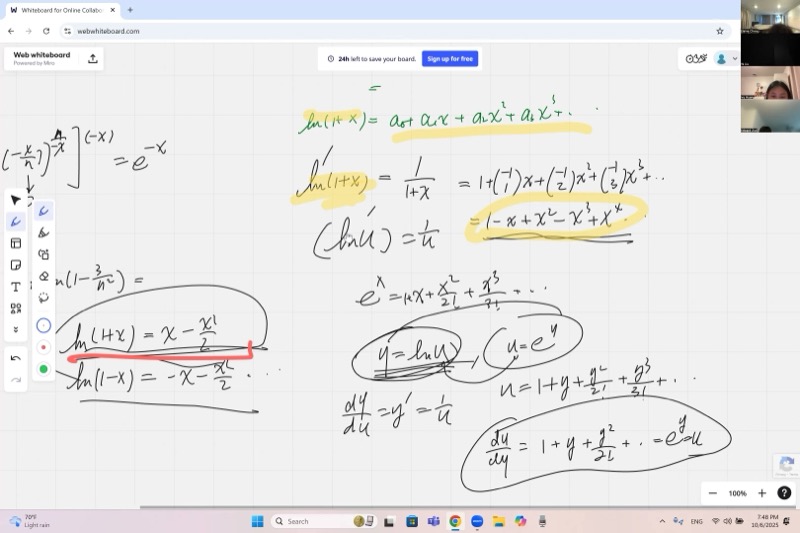
Step 1: We need the derivative of \(\ln u\). Since \(\ln\) is the inverse of \(e^x\), we write \(y = \ln u\), so \(u = e^y\). Differentiating:
\[\frac{du}{dy} = e^y = u \quad \Longrightarrow \quad \frac{dy}{du} = \frac{1}{u}\]
So \(\frac{d}{du}\ln u = \frac{1}{u}\). Note: this reciprocal relationship between the derivative of a function and its inverse only works for the first derivative.
Step 2: By the chain rule, \(\frac{d}{dx}\ln(1+x) = \frac{1}{1+x}\).
Step 3: Expand \(\frac{1}{1+x} = (1+x)^{-1}\) using the binomial/geometric series:
\[\frac{1}{1+x} = 1 - x + x^2 - x^3 + x^4 - \cdots\]
Step 4: Since \(\ln(1+x)\) is the antiderivative of \(\frac{1}{1+x}\), integrate term by term:
\[\ln(1+x) = C + x - \frac{x^2}{2} + \frac{x^3}{3} - \frac{x^4}{4} + \cdots\]
Step 5: Determine \(C\) by substituting \(x = 0\): since \(\ln(1) = 0\), we get \(C = 0\).
This series comes from integrating the geometric series \(\frac{1}{1+x} = 1 - x + x^2 - \cdots\) term by term. It is one of the most widely used expansions in calculus – the principal tool for resolving \(1^\infty\) limits.
\[\boxed{\ln(1+x) = x - \frac{x^2}{2} + \frac{x^3}{3} - \frac{x^4}{4} + \cdots}\]
Higher Derivatives via Maclaurin Coefficients
Recall the general Maclaurin expansion:
\[f(x) = \sum_{k=0}^{\infty} a_k x^k \quad \text{where} \quad a_k = \frac{f^{(k)}(0)}{k!}\]
We derive this by differentiating the power series \(k\) times and evaluating at \(x = 0\). Each differentiation peels off one power of \(x\) and multiplies by the corresponding index, until after \(k\) differentiations only the constant \(k! \cdot a_k\) survives.
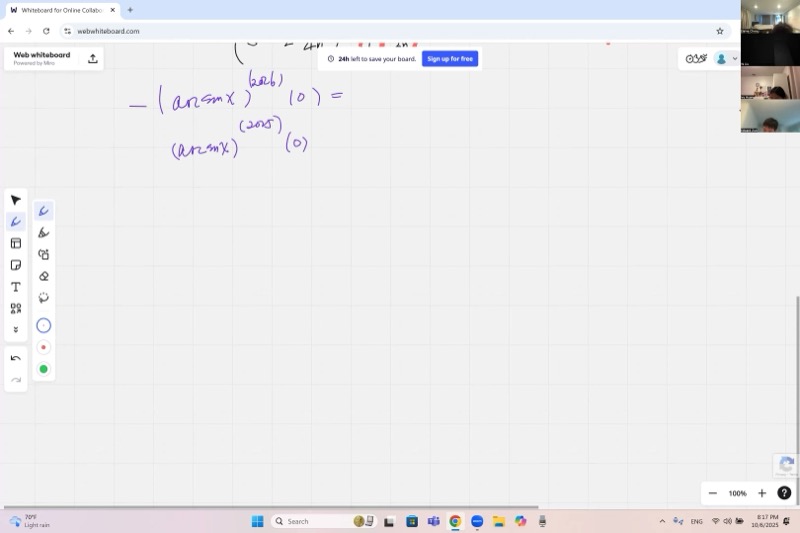
Application to arcsine: What is the 2025th derivative of \(\arcsin x\) at \(x = 0\)?
First, observe that \(\sin x\) is an odd function, and so is its inverse \(\arcsin x\). An odd function’s Maclaurin expansion contains only odd powers of \(x\):
\[\arcsin x = a_1 x + a_3 x^3 + a_5 x^5 + \cdots\]
The 2025th derivative corresponds to the coefficient of \(x^{2025}\). Since 2025 is odd, this coefficient could be nonzero – one would need to find the full expansion to determine the answer.
But what about the 2024th derivative of \(\arcsin x\) at \(x = 0\)? Since 2024 is even, there is no \(x^{2024}\) term in the expansion of an odd function. Therefore:
\[\boxed{(\arcsin x)^{(2024)}\bigg|_{x=0} = 0}\]
No computation needed – the symmetry of the function tells us the answer instantly.
Interactive demonstration – \(\arcsin x\) is an odd function:
Notice that \(\arcsin x\) (blue) is the reflection of \(\sin x\) (red dashed) across the line \(y = x\). Both are odd functions, passing through the origin with rotational symmetry.
Animated visualization – \(f\), \(f'\), and \(f''\) stacked with a linking vertical line:
Slide \(x_0\) or press Play to see how the values of \(f\), \(f'\), and \(f''\) are linked. When \(f\) reaches a maximum, \(f' = 0\) and \(f''\) is negative (concave down). The vertical dashed line connects corresponding points across all three panels.
Finding the Expansion of arcsin x (Homework Preview)
To find the actual Maclaurin expansion of \(\arcsin x\), apply the same strategy used for \(\ln(1+x)\):
- Take the derivative: \(\frac{d}{dx}\arcsin x = \frac{1}{\sqrt{1 - x^2}} = (1 - x^2)^{-1/2}\)
- Expand \((1 - x^2)^{-1/2}\) using the binomial series
- Integrate term by term to recover \(\arcsin x\)
- The constant is zero since \(\arcsin(0) = 0\)
This was assigned as homework.
Cheat Sheet
| What you want | Formula |
|---|---|
| Definition of \(e\) | \(\displaystyle\lim_{n \to \infty}\left(1 + \frac{1}{n}\right)^n = e\) |
| General variation | \(\displaystyle\lim_{n \to \infty}\left(1 + \frac{x}{n}\right)^n = e^x\) |
| Power series for \(\ln(1+x)\) | \(\ln(1+x) = x - \frac{x^2}{2} + \frac{x^3}{3} - \frac{x^4}{4} + \cdots\) |
| Logarithm technique | Set \(L = \lim\), compute \(\ln L\), then \(L = e^{\ln L}\) |
| Maclaurin coefficient formula | \(a_k = \frac{f^{(k)}(0)}{k!}\), so \(f^{(k)}(0) = k! \cdot a_k\) |
| Odd function rule | Odd functions have only odd powers in their Maclaurin series; all even derivatives at 0 are zero |
| Derivative of \(\ln u\) | \(\frac{d}{du}\ln u = \frac{1}{u}\) (proved via inverse of \(e^x\)) |
| Inverse function derivative | \(\frac{dy}{dx} = \frac{1}{dx/dy}\) (first derivative only) |
The Big Strategy for \(1^\infty\) Limits
\[\text{Set } L = \lim \;\xrightarrow{\;\text{take}\;\ln\;}\; \ln L = \lim\, m \cdot \ln(1+u) \;\xrightarrow{\;\text{expand}\;}\; \text{keep lowest order in } u \;\xrightarrow{\;\text{evaluate}\;}\; L = e^{\ln L}\]