Power Series from Known Expansions, Geometric Series, and Partial Fractions
Power series provide a means of representing complicated functions as infinite polynomials amenable to computation. This lesson develops methods for constructing power series not by computing higher-order derivatives, but by building upon known expansions. We also introduce partial fraction decomposition, a technique for expressing complicated rational functions as sums of simpler fractions, together with an efficient method for determining the coefficients.
Power series allow one to replace complicated functions with polynomial approximations, and partial fractions decompose complex rational expressions into simpler components:
- Computer graphics: Video games approximate trig and log functions with power series so that GPUs can render frames in milliseconds
- Medicine: MRI scanners reconstruct images using series expansions of signals measured from your body
- Finance: Banks use Taylor expansions to quickly estimate how bond prices change when interest rates move
- Robotics: Robot arms compute inverse kinematics using arctan expansions to convert coordinates into joint angles in real time
- Audio engineering: Equalizers decompose a signal’s transfer function using partial fractions to understand how each frequency band responds
Topics Covered
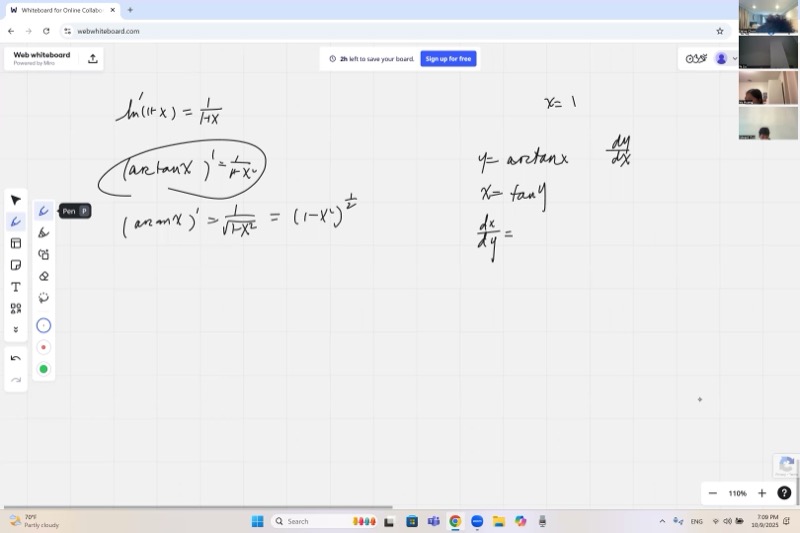
- Deriving power expansions from known series: \(\ln(1+x)\), \(\arctan x\), \(\arcsin x\)
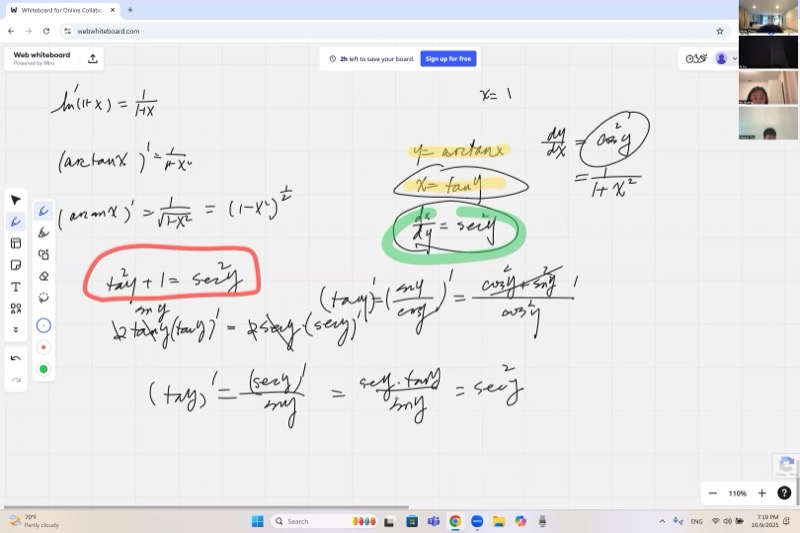
- Proving \(\frac{d}{dx}(\arctan x) = \frac{1}{1+x^2}\) via inverse functions
- Recognizing \(\frac{1}{1+x^2}\) as a geometric series: \(1 - x^2 + x^4 - x^6 + \cdots\)
- Power expansion of general rational expressions like \(\frac{1}{a + bx^n}\)
- Partial fraction decomposition: splitting a complicated fraction into simple geometric-series-ready pieces
- The cover-up trick for finding partial fraction coefficients quickly
Lecture Video
Key Frames from the Lecture
Prerequisites
A power series centered at \(x = 0\) writes a function as an infinite polynomial:
\[f(x) = a_0 + a_1 x + a_2 x^2 + a_3 x^3 + \cdots\]
The coefficients come from the derivatives of \(f\) at zero:
\[a_n = \frac{f^{(n)}(0)}{n!}\]
Once the power series is known, every derivative of \(f\) at zero is determined – and conversely.
A geometric series is a sum where each term is a fixed multiple \(r\) of the previous one:
\[1 + r + r^2 + r^3 + \cdots = \frac{1}{1 - r} \qquad \text{when } |r| < 1\]
For example, with \(r = -x^2\):
\[1 - x^2 + x^4 - x^6 + \cdots = \frac{1}{1 + x^2}\]
Recognizing a geometric series avoids the need for the full binomial expansion.
If \(y = f(x)\), then the inverse function \(f^{-1}\) reverses it: \(x = f^{-1}(y)\).
For example, \(y = \tan x\) and \(x = \arctan y\) are inverses. The key derivative relationship is:
\[\frac{dy}{dx} = \frac{1}{\;\dfrac{dx}{dy}\;}\]
Thus, if the derivative of \(\tan y\) is known, the derivative of \(\arctan x\) is obtained by taking the reciprocal.
Important: inverse functions do not distribute over arithmetic. For instance, \(\arctan x \neq \frac{\arcsin x}{\arccos x}\). One may verify: \(\arctan(1) = \frac{\pi}{4}\), but \(\frac{\arcsin(1)}{\arccos(1)} = \frac{\pi/2}{0}\), which is undefined.
For any exponent \(n\) (including negative and fractional values), the binomial expansion is:
\[(1 + u)^n = \sum_{k=0}^{\infty} \binom{n}{k} u^k = 1 + nu + \frac{n(n-1)}{2!}u^2 + \frac{n(n-1)(n-2)}{3!}u^3 + \cdots\]
When \(n\) is a negative integer, this reduces to a geometric series. For example:
\[(1 + u)^{-1} = 1 - u + u^2 - u^3 + \cdots = \frac{1}{1+u}\]
Partial fraction decomposition breaks a complicated rational function into a sum of simpler fractions. For example:
\[\frac{x^2}{(2x-1)(x-1)} = \frac{1}{2} + \frac{A}{2x-1} + \frac{B}{x-1}\]
Each simple fraction has a linear denominator, which means each one can be expanded as a geometric series. This is a powerful technique for integration and for finding power series of rational functions.
Key Concepts
Building Power Series from Known Ones
One rarely computes higher-order derivatives to find a power series. Instead, we build upon expansions already known using differentiation and integration.
Strategy: If a function’s derivative has a known power expansion, integrate the series term by term to recover the original function’s expansion.
| Target function | Take its derivative | Recognize the derivative as… |
|---|---|---|
| \(\ln(1+x)\) | \(\frac{1}{1+x}\) | Geometric series with \(r = -x\) |
| \(\arctan x\) | \(\frac{1}{1+x^2}\) | Geometric series with \(r = -x^2\) |
| \(\arcsin x\) | \(\frac{1}{\sqrt{1-x^2}}\) | Binomial expansion \((1-x^2)^{-1/2}\) |
Derivative of \(\arctan x\) via Inverse Functions
Let \(y = \arctan x\). Then \(x = \tan y\), and we differentiate the easier side:
\[\frac{dx}{dy} = \sec^2 y\]
The identity \(\frac{d}{dy}(\tan y) = \sec^2 y\) follows from the quotient rule applied to \(\frac{\sin y}{\cos y}\):
\[\frac{d}{dy}\!\left(\frac{\sin y}{\cos y}\right) = \frac{\cos y \cdot \cos y - \sin y \cdot (-\sin y)}{\cos^2 y} = \frac{\cos^2 y + \sin^2 y}{\cos^2 y} = \sec^2 y\]
Now take the reciprocal to get \(\frac{dy}{dx}\), and rewrite in terms of \(x\):
\[\frac{dy}{dx} = \cos^2 y\]
Using the identity \(1 + \tan^2 y = \sec^2 y = \frac{1}{\cos^2 y}\), we get \(\cos^2 y = \frac{1}{1 + \tan^2 y}\).
Since \(\tan y = x\):
To derive this, write \(x = \tan y\), differentiate to obtain \(\sec^2 y\), take the reciprocal, and rewrite using \(\tan y = x\). The result is a rational function that can also be expressed as a geometric series.
\[\boxed{\frac{d}{dx}(\arctan x) = \frac{1}{1 + x^2}}\]
Interactive demonstration – \(\arctan x\) and its derivative \(\frac{1}{1+x^2}\):
Drag the slider for \(a\). The green dashed tangent line has slope \(\frac{1}{1+a^2}\) (red curve). Notice the slope is largest at \(a = 0\) and decreases as \(|a|\) grows – \(\arctan x\) flattens out toward its horizontal asymptotes \(\pm\frac{\pi}{2}\).
Power Expansion of \(\arctan x\) via Geometric Series
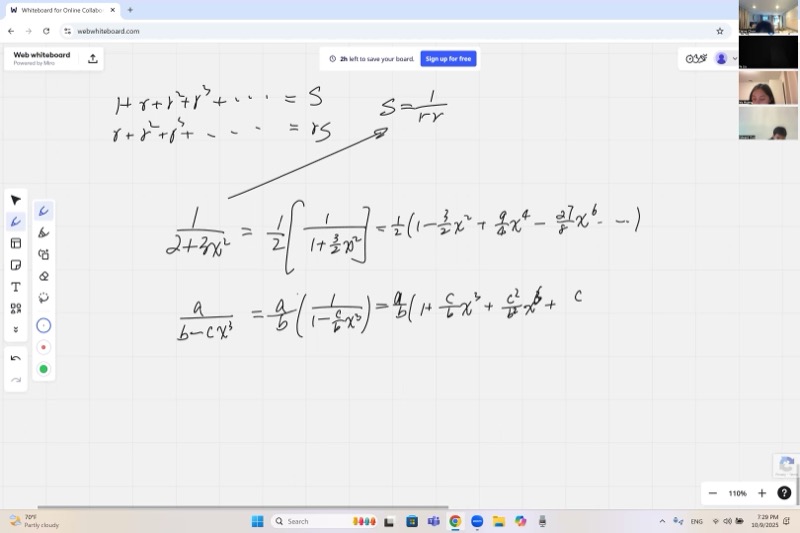
Since \(\frac{1}{1+x^2}\) is a geometric series with ratio \(r = -x^2\):
\[\frac{1}{1+x^2} = 1 - x^2 + x^4 - x^6 + \cdots \qquad (|x| < 1)\]
Integrate term by term to recover \(\arctan x\) (using \(\arctan(0) = 0\)):
Integrating the geometric series \(\frac{1}{1+x^2} = 1 - x^2 + x^4 - \cdots\) term by term yields this series. Substituting \(x = 1\) produces a well-known formula for \(\pi/4\).
\[\boxed{\arctan x = x - \frac{x^3}{3} + \frac{x^5}{5} - \frac{x^7}{7} + \cdots}\]
This beautiful result is called the Leibniz formula. Plugging in \(x = 1\) gives the famous identity:
\[\frac{\pi}{4} = 1 - \frac{1}{3} + \frac{1}{5} - \frac{1}{7} + \cdots\]
Recognizing Geometric Series in Disguise
Many power expansions are geometric series \(\frac{1}{1-r}\) in disguise. The key step is to rewrite the expression in the form \(\frac{1}{1 - (\text{something})}\).
Example 1: Expand \(\dfrac{1}{2 - 3x^2}\).
Factor out the constant to create a leading \(1\) in the denominator:
\[\frac{1}{2 - 3x^2} = \frac{1}{2} \cdot \frac{1}{1 - \frac{3}{2}x^2}\]
Now apply the geometric series with \(r = \frac{3}{2}x^2\):
\[= \frac{1}{2}\!\left(1 + \frac{3}{2}x^2 + \frac{9}{4}x^4 + \frac{27}{8}x^6 + \cdots\right)\]
\[= \frac{1}{2} + \frac{3}{4}x^2 + \frac{9}{8}x^4 + \frac{27}{16}x^6 + \cdots\]
Example 2: Expand \(\dfrac{a}{b - cx^3}\).
Factor out \(b\) from the denominator:
\[\frac{a}{b - cx^3} = \frac{a}{b} \cdot \frac{1}{1 - \frac{c}{b}x^3}\]
Apply the geometric series with \(r = \frac{c}{b}x^3\):
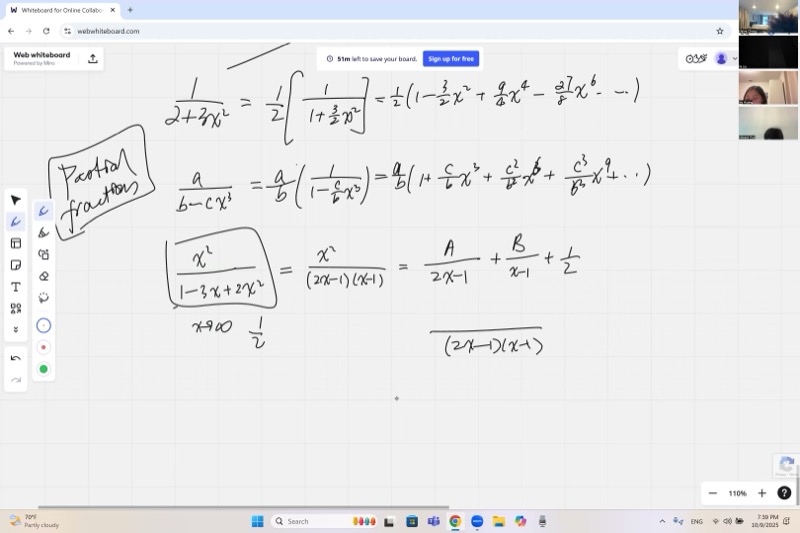
\[= \frac{a}{b}\!\left(1 + \frac{c}{b}x^3 + \frac{c^2}{b^2}x^6 + \frac{c^3}{b^3}x^9 + \cdots\right)\]
Interactive demonstration – comparing a rational function with its geometric series approximation:
Drag the slider \(n\) to add more terms. Watch how the red dashed approximation hugs the blue curve more closely within the radius of convergence \(|x| < \sqrt{2/3} \approx 0.82\).
Animated visualization – geometric series partial sums accumulating toward \(\frac{1}{1-x}\):
Partial Fraction Decomposition
When a denominator factors into linear terms, we can decompose the fraction into simpler pieces, each of which yields a geometric series.
Example: Expand \(\dfrac{x^2}{2x^2 - 3x + 1}\) as a power series.
Step 1 – Check degrees. The numerator has degree 2 and the denominator has degree 2, so this is not a proper fraction. When \(x \to \infty\), the function approaches \(\frac{x^2}{2x^2} = \frac{1}{2}\). So we first extract the polynomial part:
\[\frac{x^2}{2x^2 - 3x + 1} = \frac{1}{2} + \frac{\text{remainder}}{2x^2 - 3x + 1}\]
Step 2 – Factor the denominator.
\[2x^2 - 3x + 1 = (2x - 1)(x - 1)\]
Step 3 – Set up partial fractions. After extracting \(\frac{1}{2}\), write:
\[\frac{x^2}{(2x-1)(x-1)} = \frac{1}{2} + \frac{A}{2x-1} + \frac{B}{x-1}\]
Step 4 – Find coefficients by clearing denominators and comparing like terms. Multiply through by \((2x-1)(x-1)\):
\[x^2 - \tfrac{1}{2}(2x-1)(x-1) = A(x-1) + B(2x-1)\]
The left side simplifies to \(x^2 - \tfrac{1}{2}(2x^2 - 3x + 1) = \tfrac{3}{2}x - \tfrac{1}{2}\). Matching coefficients of \(x\) and the constant term gives:
\[A + 2B = \tfrac{3}{2}, \qquad -A - B = -\tfrac{1}{2}\]
Solving: \(B = 1\) and \(A = -\tfrac{1}{2}\).
\[\frac{x^2}{(2x-1)(x-1)} = \frac{1}{2} - \frac{1/2}{2x-1} + \frac{1}{x-1}\]
Step 5 – Expand each fraction as a geometric series:
\[\frac{1}{2x - 1} = \frac{-1}{1 - 2x} = -(1 + 2x + 4x^2 + 8x^3 + \cdots)\]
\[\frac{1}{x - 1} = \frac{-1}{1 - x} = -(1 + x + x^2 + x^3 + \cdots)\]
Combine everything to get the full power series of the original function.
The Cover-Up Trick for Partial Fractions
Finding \(A\) and \(B\) by clearing denominators and matching coefficients is tedious. The following method uses a strategic choice of \(x\)-value to simplify the computation.
To find \(B\): choose \(x\) so that the factor \((x - 1)\) vanishes, i.e., set \(x = 1\). Then the \(A\)-term has a finite value while we are effectively “covering up” the \((x-1)\) factor:
\[B = \left.\frac{x^2 - \frac{1}{2}(2x-1)(x-1)}{2x - 1}\right|_{x=1} = \frac{\frac{3}{2}(1) - \frac{1}{2}}{2(1)-1} = 1\]
To find \(A\): set \(x = \frac{1}{2}\) so that \((2x - 1)\) vanishes:
\[A = \left.\frac{x^2 - \frac{1}{2}(2x-1)(x-1)}{x - 1}\right|_{x=1/2} = \frac{\frac{3}{2}\!\cdot\!\frac{1}{2} - \frac{1}{2}}{\frac{1}{2} - 1} = \frac{1/4}{-1/2} = -\frac{1}{2}\]
The idea: choose an \(x\)-value that zeroes out one denominator, making only one unknown survive. No systems of equations are needed.
Interactive demonstration – partial fraction decomposition of a rational function:
The blue curve is the original function. The red and green dashed curves are the partial fraction pieces. Gray dashed lines mark the vertical asymptotes at \(x = \frac{1}{2}\) and \(x = 1\); the purple dashed line marks the horizontal asymptote at \(y = \frac{1}{2}\).
Animated visualization – partial fraction decomposition: splitting a rational function into simpler parts:
Press Play to watch the original rational function (blue) being decomposed into its constituent parts: a constant (purple), and two simpler fractions (red, green) – one for each pole.
Power Expansion of \(\ln(1+x)\) and \(\arcsin x\)
For completeness, here are the other two expansions built by the same “differentiate, expand, integrate” strategy discussed in class:
Natural log: Since \(\frac{d}{dx}\ln(1+x) = \frac{1}{1+x} = 1 - x + x^2 - x^3 + \cdots\), integrating gives:
\[\ln(1+x) = x - \frac{x^2}{2} + \frac{x^3}{3} - \frac{x^4}{4} + \cdots\]
Arcsine: Since \(\frac{d}{dx}\arcsin x = (1 - x^2)^{-1/2}\), we use the binomial expansion:
\[(1-x^2)^{-1/2} = 1 + \frac{1}{2}x^2 + \frac{3}{8}x^4 + \frac{5}{16}x^6 + \cdots\]
Integrating term by term:
\[\arcsin x = x + \frac{x^3}{6} + \frac{3x^5}{40} + \frac{5x^7}{112} + \cdots\]
Notice that all even-order derivatives of \(\arcsin x\) at \(x = 0\) are zero (only odd powers appear), which the power series makes immediately visible.
Cheat Sheet
| Formula | Key idea |
|---|---|
| \(\dfrac{d}{dx}(\arctan x) = \dfrac{1}{1+x^2}\) | Write \(x = \tan y\), differentiate, take reciprocal |
| \(\dfrac{1}{1-r} = 1 + r + r^2 + r^3 + \cdots\) | Geometric series (valid for \(\lvert r\rvert < 1\)) |
| \(\arctan x = x - \dfrac{x^3}{3} + \dfrac{x^5}{5} - \cdots\) | Integrate the geometric series for \(\frac{1}{1+x^2}\) |
| \(\ln(1+x) = x - \dfrac{x^2}{2} + \dfrac{x^3}{3} - \cdots\) | Integrate the geometric series for \(\frac{1}{1+x}\) |
Geometric Series Conversion Recipe
To expand \(\dfrac{1}{a + bx^n}\):
- Factor out \(a\): \(\;\dfrac{1}{a} \cdot \dfrac{1}{1 + \frac{b}{a}x^n}\)
- Identify \(r = -\dfrac{b}{a}x^n\) and apply \(\dfrac{1}{1-r} = 1 + r + r^2 + \cdots\)
Partial Fraction Steps
- If degree of numerator \(\geq\) degree of denominator, do polynomial long division first
- Factor the denominator into linear terms
- Write \(\dfrac{A}{(\text{factor}_1)} + \dfrac{B}{(\text{factor}_2)} + \cdots\)
- Find \(A, B, \ldots\) by the cover-up trick: plug in the root of each factor to isolate one unknown at a time
- Expand each simple fraction as a geometric series
The Cover-Up Trick
To find the coefficient for a given linear factor, set \(x\) equal to the root of that factor. This zeroes out every other partial fraction term, leaving only the one sought. No systems of equations are needed.