Related Rates: Connecting Changing Quantities with Derivatives
This lesson introduces the method of related rates, a technique for connecting the rates of change of quantities that are linked by a geometric or physical relationship. Given information about how one quantity varies with time, one can determine how a related quantity changes by differentiating an appropriate equation – using the Pythagorean theorem and the chain rule as foundational tools.
Related rates problems arise whenever two or more quantities change simultaneously and are connected by an equation:
- Traffic engineering: determining how fast two vehicles are closing on each other at an intersection informs traffic signal design
- Pharmacokinetics: as a drug distributes through the body, related rates predict how rapidly the concentration changes in the bloodstream
- Fluid dynamics: when water flows into a vessel at a steady rate, related rates determine how fast the water level rises – particularly when the vessel has non-uniform cross-section
- Optics and shadows: as an object moves away from a light source, the rate of shadow growth is determined by related rates
- Meteorology: as a weather balloon ascends, related rates connect its altitude to the rate of change of the angle of elevation measured at a ground station
These are all situations in which knowledge of one rate of change determines another.
Topics Covered
- What a rate is: change of one quantity per unit change of another
- What related rates means: multiple variables changing simultaneously, linked by an equation
- Setting up related rates problems using the Pythagorean theorem: \(C^2 = A^2 + B^2\)
- Applying the chain rule to differentiate both sides with respect to time \(t\)
- The classic two-car intersection problem (3-4-5 right triangle)
- Interpreting \(\frac{dA}{dt}\), \(\frac{dB}{dt}\), and \(\frac{dC}{dt}\) in real-world context
Lecture Video
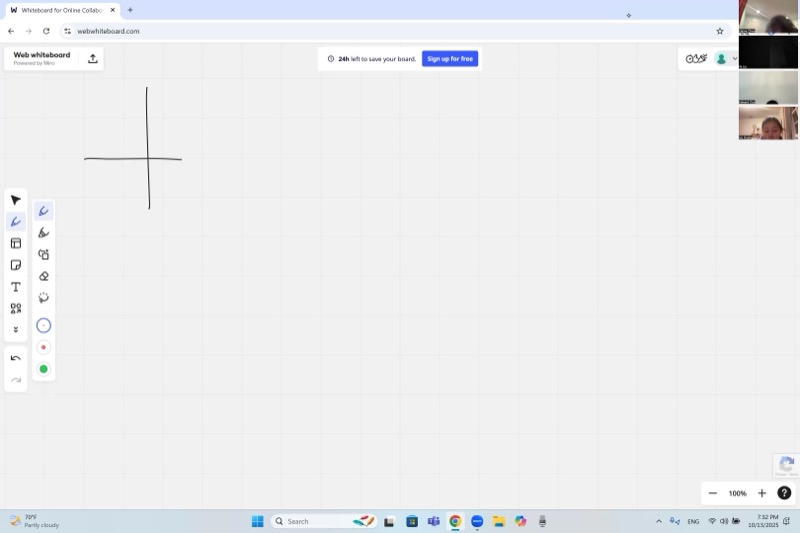
Key Frames from the Lecture

Prerequisites
A rate of change measures how fast one quantity changes with respect to another.
- Speed is a rate: distance per time, like \(60 \text{ mph}\)
- Growth rate: height per year
- In calculus notation, if \(y\) depends on \(t\), the rate of change is \(\frac{dy}{dt}\)
A rate is always “something per something.” If a car travels 120 miles in 2 hours, its rate is \(\frac{120}{2} = 60\) miles per hour.
The derivative of a function gives its instantaneous rate of change – the rate at which the output changes at a given instant.
We write it as \(\frac{dy}{dx}\) or \(f'(x)\).
For example, if \(y = x^2\), then \(\frac{dy}{dx} = 2x\), which indicates that at \(x = 3\), the function is changing at a rate of \(6\) units of \(y\) per unit of \(x\).
The chain rule provides the derivative of a composition of functions. If \(y\) depends on \(u\), and \(u\) depends on \(x\), then:
\[\frac{dy}{dx} = \frac{dy}{du} \cdot \frac{du}{dx}\]
In related rates, all quantities change with respect to time \(t\). If \(C^2 = A^2 + B^2\) and both \(A\) and \(B\) change over time, one differentiates both sides with respect to \(t\), applying the chain rule to each term.
For any right triangle with legs \(a\) and \(b\) and hypotenuse \(c\):
\[a^2 + b^2 = c^2\]
Standard right triangles to recall:
- 3-4-5: \(3^2 + 4^2 = 9 + 16 = 25 = 5^2\)
- 5-12-13: \(5^2 + 12^2 = 25 + 144 = 169 = 13^2\)
These ratios scale: a 300-400-500 triangle is just a 3-4-5 triangle multiplied by 100.
When \(y\) cannot be expressed explicitly as a function of \(x\), implicit differentiation allows one to differentiate both sides of the equation as given.
For example, given \(x^2 + y^2 = 25\), differentiate both sides with respect to \(x\):
\[2x + 2y \frac{dy}{dx} = 0 \implies \frac{dy}{dx} = -\frac{x}{y}\]
In related rates problems, the same procedure is applied, differentiating with respect to time \(t\).
Key Concepts
What Is a Rate?
A rate is a ratio of how one quantity changes with respect to another:
\[\text{rate} = \frac{\Delta(\text{output})}{\Delta(\text{input})}\]
In calculus, we make this instantaneous by taking a derivative. If a car’s position is \(s(t)\), its speed is:
\[v(t) = \frac{ds}{dt}\]
The Two-Car Intersection Problem
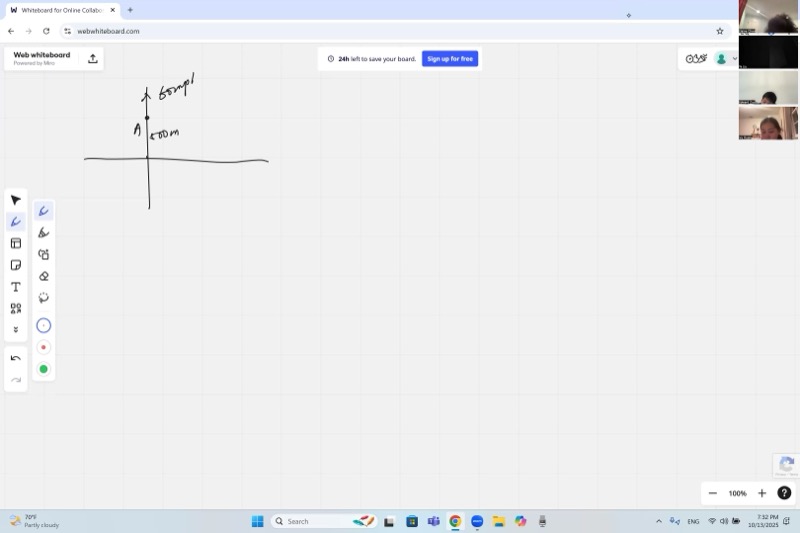
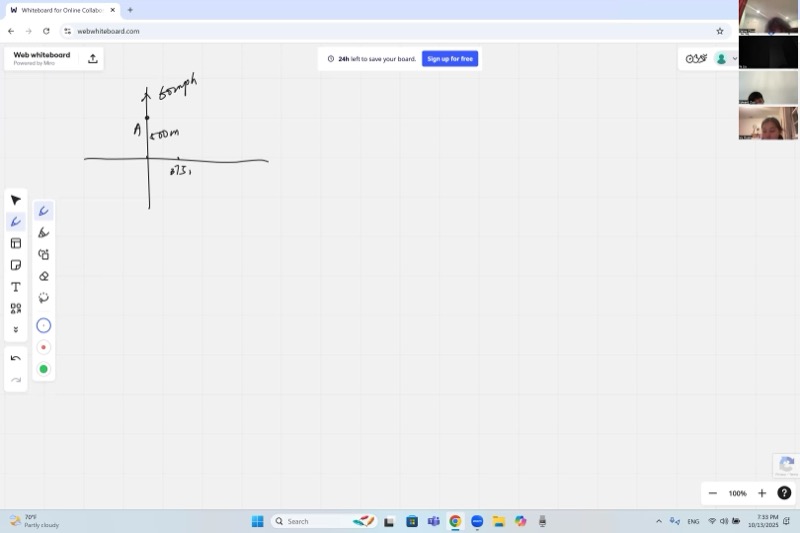
Here is the classic setup from the lecture. Two cars approach an intersection (a crossroad with a traffic light):
- Car A is \(500\) m east of the intersection, driving northward
- Car B is \(375\) m north of the intersection
- Car A’s speed is \(60\) mph heading toward the intersection
The positions form a right triangle, with the distance between the cars as the hypotenuse.
Interactive demonstration – the right triangle formed by the two cars’ positions:
Setting Up the Equation
Let \(A(t)\) be the horizontal distance of Car A from the intersection, and \(B(t)\) be the vertical distance of Car B. The distance \(C(t)\) between the two cars satisfies:
\[C^2 = A^2 + B^2\]
This is the Pythagorean theorem — the key equation that relates the variables.
Differentiating with Respect to Time
Now apply \(\frac{d}{dt}\) to both sides. Every variable depends on \(t\), so we use the chain rule:
\[\frac{d}{dt}\left(C^2\right) = \frac{d}{dt}\left(A^2\right) + \frac{d}{dt}\left(B^2\right)\]
\[2C \,\frac{dC}{dt} = 2A \,\frac{dA}{dt} + 2B \,\frac{dB}{dt}\]
Divide both sides by \(2\):
When two distances form the legs of a right triangle and everything is changing over time, you can link all three rates of change together by differentiating the Pythagorean theorem. This single equation is the foundation for solving any right-triangle related rates problem.
\[\boxed{C \,\frac{dC}{dt} = A \,\frac{dA}{dt} + B \,\frac{dB}{dt}}\]
This is the related rates equation. It connects the three rates \(\frac{dA}{dt}\), \(\frac{dB}{dt}\), and \(\frac{dC}{dt}\).
Solving for the Unknown Rate
Suppose at the moment in question:
- \(A = 500\) m, \(B = 375\) m
- Note that \(500 : 375 = 4 : 3\), so this is a scaled 3-4-5 right triangle
- Therefore \(C = \sqrt{500^2 + 375^2} = \sqrt{250000 + 140625} = \sqrt{390625} = 625\) m (which is \(5 \times 125\))
- Car A moves toward the intersection at \(60\) mph, so \(\frac{dA}{dt} = -60\) (negative because \(A\) is decreasing)
If we want to find \(\frac{dC}{dt}\) (the rate at which the distance between the cars is changing), we substitute:
\[625 \cdot \frac{dC}{dt} = 500 \cdot (-60) + 375 \cdot \frac{dB}{dt}\]
With a known value for \(\frac{dB}{dt}\) (the speed of Car B), we can solve for \(\frac{dC}{dt}\).
When a car moves toward the intersection, its distance from the intersection is decreasing. A decreasing quantity has a negative derivative. So if Car A approaches at 60 mph, we write \(\frac{dA}{dt} = -60\).
Correctly assigning signs is one of the most common sources of error in related rates. One should always determine whether each distance is increasing or decreasing.
Visualizing How \(C\) Changes Over Time
Watch how the hypotenuse \(C\) changes as Car A moves toward the intersection at a constant speed (with Car B stationary):
Notice that \(C(t)\) is not a straight line even though \(A(t)\) decreases linearly. This is because \(C = \sqrt{A^2 + B^2}\) is a nonlinear function of \(A\). The rate \(\frac{dC}{dt}\) itself is changing over time — this is why we must specify the instant at which we evaluate it.
Another Classic Example: Expanding Circle
Many related rates problems involve geometry. Suppose a stone is dropped into a pond, creating a circular ripple whose radius \(r\) increases at a constant rate:
\[\frac{dr}{dt} = 2 \text{ m/s}\]
How fast is the area increasing when \(r = 10\) m?
Step 1 — Write the equation relating area and radius:
\[A = \pi r^2\]
Step 2 — Differentiate both sides with respect to \(t\):
If a circle’s radius is growing, its area grows faster and faster because the area formula is nonlinear. Differentiating \(A = \pi r^2\) gives you a direct link between the rate the radius changes and the rate the area changes.
\[\frac{dA}{dt} = 2\pi r \,\frac{dr}{dt}\]
Step 3 — Substitute \(r = 10\) and \(\frac{dr}{dt} = 2\):
\[\frac{dA}{dt} = 2\pi(10)(2) = 40\pi \approx 125.7 \text{ m}^2/\text{s}\]
Even though the radius grows at a constant rate, the area grows faster and faster because \(\frac{dA}{dt}\) depends on \(r\), which is increasing.
Animated demonstration – expanding circle with dr/dt and dA/dt:
Animated demonstration – sliding ladder against a wall:
A ladder of length \(L\) leans against a vertical wall. As the base slides outward, the top slides down. The Pythagorean theorem gives \(x^2 + y^2 = L^2\), and differentiating: \(x\frac{dx}{dt} + y\frac{dy}{dt} = 0\).
Cheat Sheet
| Formula | When to Use |
|---|---|
| \(C^2 = A^2 + B^2\) | Right triangle relating distances |
| \(2C\frac{dC}{dt} = 2A\frac{dA}{dt} + 2B\frac{dB}{dt}\) | Pythagorean related rates |
| \(A = \pi r^2 \implies \frac{dA}{dt} = 2\pi r\frac{dr}{dt}\) | Expanding/shrinking circle |
| \(V = \frac{4}{3}\pi r^3 \implies \frac{dV}{dt} = 4\pi r^2 \frac{dr}{dt}\) | Expanding/shrinking sphere |
| \(V = \frac{1}{3}\pi r^2 h\) | Cone filling with liquid |
Key Rules for Signs
- Distance decreasing \(\implies\) \(\frac{d(\cdot)}{dt} < 0\)
- Distance increasing \(\implies\) \(\frac{d(\cdot)}{dt} > 0\)
- Always define a positive direction in your diagram