Related Rates: Distance, Shadows & Velocity Decomposition
This lesson presents several complete related rates problems – two cars at a crossroad, a boat being pulled toward a cliff, and the rate at which a shadow moves when a person walks away from a streetlight. We also introduce the technique of velocity decomposition from physics, which in certain cases bypasses the algebraic computation entirely. The lesson concludes with a systematic procedure applicable to any related rates problem.
Related rates problems address the question: given that one quantity is changing, at what rate does a connected quantity change? Such problems arise in numerous applied settings:
- Navigation: air traffic controllers monitor how rapidly the distance between two aircraft is changing to ensure safe separation
- Civil engineering: engineers compute how fast a shadow moves to plan lighting for structures and stadiums
- Rescue operations: coast guard teams determine the required rate of reeling in a towline to bring a boat to shore at an appropriate speed
- Pharmacokinetics: physicians model how rapidly drug concentration in the blood changes based on IV drip rates
- Kinematics: the rate at which the gap between two moving objects closes is determined by related rates
In this lesson, we solve several classic related rates problems using both calculus (implicit differentiation) and physics (velocity decomposition).
Topics Covered
- Setting up related rates problems: identifying variables, given rates, and sought rates
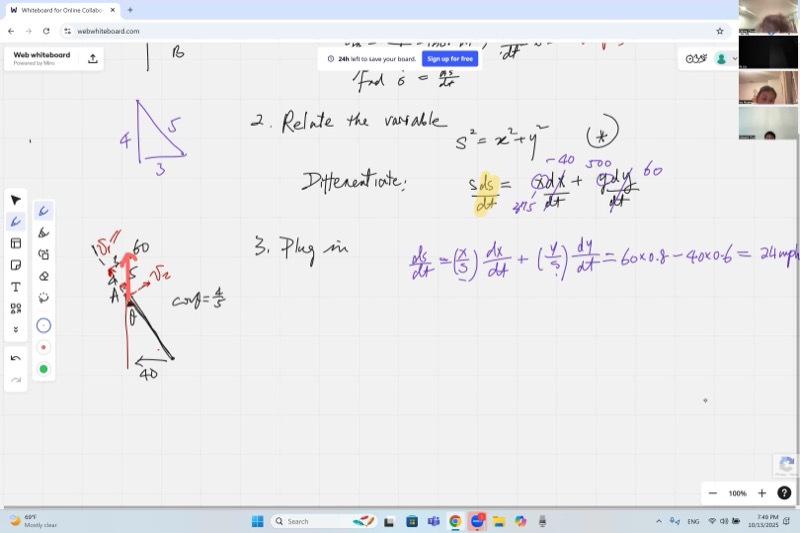
- Using the Pythagorean theorem \(s^2 = x^2 + y^2\) to relate distances
- Differentiating implicit equations: \(s\,ds = x\,dx + y\,dy\)
- Dividing by \(dt\) to convert differentials into rates
- Two cars at a crossroad: finding \(\dfrac{ds}{dt}\) from \(\dfrac{dx}{dt}\) and \(\dfrac{dy}{dt}\)
- Velocity decomposition: projecting motion onto the radial direction
- Boat-and-cliff problem: reeling in a rope connected to a boat
- Shadow problems using similar triangles to relate variables
- Distinguishing variables from constants in problem setup
Lecture Video
Key Frames from the Lecture
Prerequisites
Given an equation such as \(x^2 + y^2 = s^2\) in which \(x\), \(y\), and \(s\) all depend on time \(t\), one cannot simply differentiate with respect to \(x\). Instead, each term is differentiated with respect to its own variable:
\[2x\,dx + 2y\,dy = 2s\,ds\]
Then divide both sides by \(dt\) to get rates:
\[2x\frac{dx}{dt} + 2y\frac{dy}{dt} = 2s\frac{ds}{dt}\]
This is implicit differentiation – treating all changing quantities as variables simultaneously.
For a right triangle with legs \(a\) and \(b\) and hypotenuse \(c\):
\[a^2 + b^2 = c^2\]
This is the go-to equation for distances in perpendicular directions. For related rates, the key is recognizing which sides are variables and which are constants.
Two triangles are similar if they have the same angles. When triangles are similar, their corresponding sides are proportional:
\[\frac{a_1}{a_2} = \frac{b_1}{b_2} = \frac{c_1}{c_2}\]
Shadow problems almost always involve similar triangles formed by a light source, an object, and the shadow.
Any velocity vector can be broken into two perpendicular components. To determine how motion affects a particular direction (say, the distance between two objects), one projects the velocity onto that direction:
\[v_{\text{radial}} = v \cos\theta\]
where \(\theta\) is the angle between the velocity and the direction you care about. The perpendicular component \(v \sin\theta\) does not affect the distance – it only causes rotation.
Problem 1: Two Cars at a Crossroad
Setup
Two cars are at a crossroad. Car A drives north at \(60\) mph, and Car B drives west (toward the intersection) at \(40\) mph. At the moment of interest, Car A is \(500\) m north and Car B is \(375\) m east. How fast is the distance between them changing?
The green dashed line is the distance \(s\) between the two cars. The triangle has legs \(x = 375\) and \(y = 500\), forming a 3-4-5 ratio.
Solution by Velocity Decomposition (Physics Way)
Instead of algebra, decompose each car’s velocity into the radial direction (along the line connecting A and B) and the tangential direction (perpendicular to it). Only the radial component affects the distance between the cars.
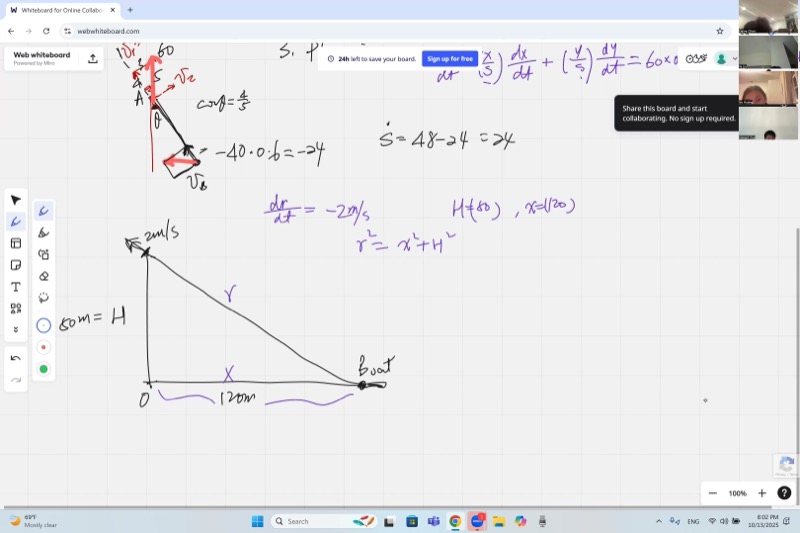
Car A moves at \(60\) mph upward. The triangle \(OAB\) has ratio \(3:4:5\), so the projection of Car A’s velocity onto the radial direction uses \(\cos\theta = \frac{4}{5}\):
\[v_{r,A} = 60 \times \frac{4}{5} = 48 \text{ mph (increasing distance)}\]
Car B moves at \(40\) mph to the left. Projecting onto the radial direction with \(\sin\theta = \frac{3}{5}\):
\[v_{r,B} = 40 \times \frac{3}{5} = 24 \text{ mph (decreasing distance)}\]
The net rate of change:
\[\frac{ds}{dt} = 48 - 24 = 24 \text{ mph}\]
The same answer is obtained – and the computation is nearly immediate once one recognizes the \(3\)-\(4\)-\(5\) ratio.
Problem 2: Boat and Cliff (Rope Problem)
Setup
A person stands atop a \(50\) m cliff and pulls in a rope attached to a boat at \(2\) m/s. At the moment of interest, the boat is \(120\) m from the base of the cliff. How fast is the boat approaching the cliff?
The dashed red line is the rope of length \(r = 130\). The cliff height \(h = 50\) is constant – only \(x\) and \(r\) are variables.
Solution by Velocity Decomposition
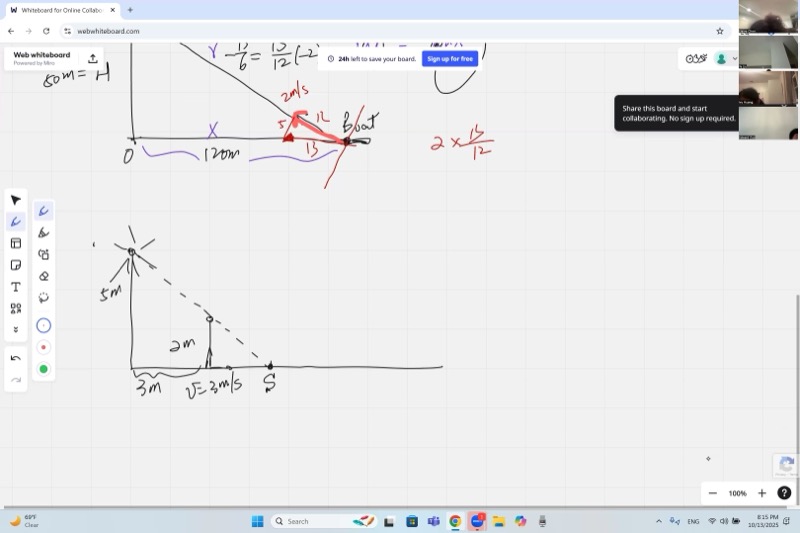
The rope shrinks at \(2\) m/s – that is the radial component of the boat’s velocity. The boat moves horizontally, so its full velocity \(v\) projects onto the rope direction as \(v \cdot \frac{12}{13}\). Setting this equal to \(2\):
\[v = 2 \times \frac{13}{12} = \frac{13}{6} \text{ m/s}\]
The result follows immediately upon recognizing the \(5\)-\(12\)-\(13\) triangle.
Problem 3: Shadow of a Walking Person
Setup
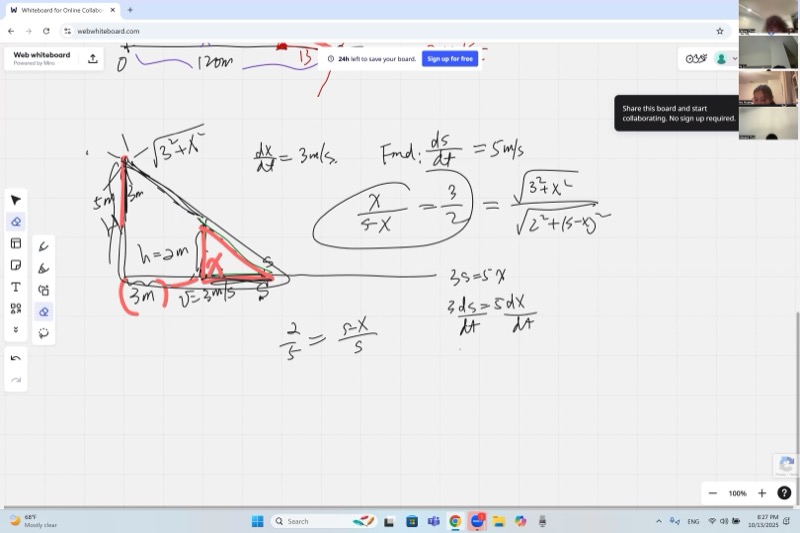
A lamppost is \(5\) m tall. A \(2\) m tall person walks away from the lamp at \(3\) m/s. When the person is \(3\) m from the lamp, how fast is the tip of their shadow moving?
Drag the slider \(t\) to move the person. Watch how the shadow tip (green dot) always moves proportionally – the ratio \(s/x = 5/3\) never changes.
Solution
Variables and constants:
- \(x\) = distance from person to lamppost (variable), with \(\frac{dx}{dt} = 3\) m/s
- \(s\) = distance from shadow tip to lamppost (variable); find \(\frac{ds}{dt}\)
- Heights \(H = 5\) m (lamp) and \(h = 2\) m (person) are constants
Relate using similar triangles. The big triangle (lamp to shadow tip, height \(5\), base \(s\)) is similar to the small triangle (person to shadow tip, height \(2\), base \(s - x\)):
\[\frac{x}{s - x} = \frac{H - h}{h} = \frac{5 - 2}{2} = \frac{3}{2}\]
Cross multiply:
\[2x = 3(s - x) = 3s - 3x \quad \Longrightarrow \quad 5x = 3s\]
Differentiate:
\[5\,dx = 3\,ds \quad \Longrightarrow \quad \frac{ds}{dt} = \frac{5}{3}\cdot\frac{dx}{dt} = \frac{5}{3} \times 3 = 5 \text{ m/s}\]
When similar triangles create a linear relationship between two variables (like \(5x = 3s\)), their rates of change are locked in the same ratio. That is why the shadow tip speed is constant no matter where the person stands.
\[\boxed{\frac{ds}{dt} = 5 \text{ m/s}}\]
A striking result: the shadow tip moves at a constant \(5\) m/s regardless of where the person is. Because the relationship between \(s\) and \(x\) is linear, their rates are in a fixed ratio.
Animated demonstration – shadow of a walking person:
Problem 4: Shadow on a Wall
Setup
A lamp is \(3\) m high, and a \(2.5\) m tall person stands between the lamp and a wall \(4\) m away. The person walks toward the wall at \(3\) m/s and is currently \(1\) m from the lamp. How fast is the shadow moving on the wall?
Solution
Variables and constants:
- \(x\) = distance from person to lamp (variable), \(\frac{dx}{dt} = 3\) m/s
- \(y\) = height of shadow on the wall (variable); find \(\frac{dy}{dt}\)
- Lamp height \(= 3\) m, person height \(= 2.5\) m, wall distance \(= 4\) m are all constants
Relate using similar triangles. The light at height \(3\) casts a ray over the person’s head (height \(2.5\)) onto the wall. By similar triangles:
\[\frac{x}{4 - x} = \frac{3 - 2.5}{y - 3} \quad \Longrightarrow \quad x(y - 3) = 0.5(4 - x) \quad \Longrightarrow \quad xy = 2 + 2.5x\]
Differentiate using the product rule on \(xy\), then divide by \(dt\):
\[y\frac{dx}{dt} + x\frac{dy}{dt} = 2.5\frac{dx}{dt}\]
Substitute. At \(x = 1\): \(y = 2 + 2.5 = 4.5\) m.
\[4.5(3) + 1 \cdot \frac{dy}{dt} = 2.5(3) \quad \Longrightarrow \quad \frac{dy}{dt} = 7.5 - 13.5 = -6\]
\[\boxed{\frac{dy}{dt} = -6 \text{ m/s}}\]
The negative sign means the shadow is moving down the wall at \(6\) m/s. Unlike Problem 3, the \(xy\) product makes this relationship nonlinear – the shadow speed depends on position.
Common Mistakes to Avoid
Substituting numerical values too early. Substituting \(x = 3\) before differentiating yields \(\frac{d}{dt}(3) = 0\) – a meaningless result. The equation must hold at every instant.
Confusing variables and constants. The cliff height \(h = 50\) is fixed, so \(dh = 0\). The position \(x\) varies, so \(dx \neq 0\). All quantities should be classified at the outset.
Incorrect signs. If a quantity is decreasing, its rate is negative. Car B approaching means \(\frac{dx}{dt} < 0\); rope being reeled in means \(\frac{dr}{dt} < 0\).
Differentiating prematurely with respect to a single variable. Each variable should receive its own differential (\(2r\,dr = 2x\,dx\)); division by \(dt\) is performed afterward.
Cheat Sheet
| What you need | Formula |
|---|---|
| Pythagorean relation | \(s^2 = x^2 + y^2\) |
| Differentiated Pythagorean | \(s\dfrac{ds}{dt} = x\dfrac{dx}{dt} + y\dfrac{dy}{dt}\) |
| Similar triangles | \(\dfrac{a_1}{a_2} = \dfrac{b_1}{b_2}\) (corresponding sides proportional) |
| Radial projection | \(v_{\text{radial}} = v\cos\theta\) (component along the distance direction) |
| Related rates procedure | (1) Set up variables and rates, (2) Relate variables, (3) Differentiate and plug in |
| Product rule differential | \(d(xy) = y\,dx + x\,dy\) |
| Key principle | Only the radial component of velocity changes the distance between two objects |