Related Rates via the Physics (Vector Projection) Method
This lesson presents the vector projection method for solving related rates problems involving rigid objects such as rods and beams – a technique that determines velocities without explicit differentiation. We also prove the Law of Sines using the circumscribed circle, establishing one of the fundamental results in triangle geometry.
Understanding how the velocities of connected objects relate to each other arises in numerous engineering and physical applications:
- Robotics: a robotic arm consists of rigid links connected at joints – engineers use velocity projections to determine how fast the end effector moves when a motor actuates one joint
- Mechanical engineering: pistons and crankshafts are connected by rigid rods, and the piston speed is determined by projecting the crankshaft’s velocity along the rod direction
- Biomechanics: when a bat swings, every point on the bat moves at a different speed – the rigid-body constraint determines the tip velocity relative to the handle
- Structural engineering: as a crane arm rotates, the cable attachment point moves along a circle and the load swings – predicting the load’s velocity requires decomposing motion along and perpendicular to the cable
- Computational physics: physics engines simulate rigid bodies by enforcing constraints on the motion of connected parts, using the projection methods developed in this lesson
Topics Covered
- Related rates for rigid bodies using the vector projection method (no derivatives needed)
- Velocity decomposition into radial and tangential components along a rigid rod
- Rigid body constraint: radial components of velocity at both ends must be equal
- The result \(v = u \dfrac{\cos\theta}{\cos\phi}\) for a rod sliding along two walls
- Law of Cosines: \(a^2 = b^2 + c^2 - 2bc\cos A\)
- Law of Sines: \(\dfrac{a}{\sin A} = \dfrac{b}{\sin B} = \dfrac{c}{\sin C} = 2R\)
- Proof of the Law of Sines using the circumcircle and inscribed angle theorem
- Circumscribed circle uniqueness via perpendicular bisectors
- Inscribed angle theorem: circumferential angle \(= \frac{1}{2} \times\) central angle
Lecture Video
Key Frames from the Lecture
Prerequisites
The Law of Cosines generalizes the Pythagorean theorem to any triangle. For a triangle with sides \(a\), \(b\), \(c\) and the angle \(A\) opposite side \(a\):
\[a^2 = b^2 + c^2 - 2bc\cos A\]
When \(A = 90°\), we get \(\cos A = 0\) and this reduces to \(a^2 = b^2 + c^2\), which is just the Pythagorean theorem. This formula determines a missing side given two sides and the included angle, or a missing angle given all three sides.
Any velocity vector can be decomposed (split) into two perpendicular components. For example, if you have a velocity \(\vec{v}\) and a reference direction, you can write:
\[\vec{v} = v_{\text{radial}} + v_{\text{tangential}}\]
where:
- \(v_{\text{radial}} = |\vec{v}|\cos\alpha\) is the component along the reference direction
- \(v_{\text{tangential}} = |\vec{v}|\sin\alpha\) is the component perpendicular to it
Here \(\alpha\) is the angle between \(\vec{v}\) and the reference direction. This is the standard projection of a vector onto a line using the cosine function.
A rigid body is an object that cannot stretch, shrink, or deform. A rigid rod of length \(L\) means that the distance between its two endpoints is always exactly \(L\), no matter how it moves.
This gives us a powerful constraint: the rate at which the distance between the endpoints changes must always be zero:
\[\frac{dL}{dt} = 0\]
In the physics/vector approach, this means the radial components of velocity at both ends (the parts that would stretch or compress the rod) must be equal.
The circumcircle (or circumscribed circle) is the unique circle that passes through all three vertices of a triangle. Its center is called the circumcenter, and its radius is called the circumradius \(R\).
The circumcenter is found at the intersection of the perpendicular bisectors of any two sides. Since a perpendicular bisector of a segment is the set of all points equidistant from the two endpoints, the circumcenter is equidistant from all three vertices.
The inscribed angle theorem states that any angle inscribed in a circle (formed by two chords meeting at a point on the circle) is exactly half the central angle that subtends the same arc:
\[\text{inscribed angle} = \frac{1}{2} \times \text{arc measurement}\]
A key consequence: an angle inscribed in a semicircle (facing a diameter) is always \(90°\), because the semicircular arc measures \(\pi\) radians and \(\frac{\pi}{2} = 90°\).
The L-Shaped Wall Problem
Setting Up the Geometry
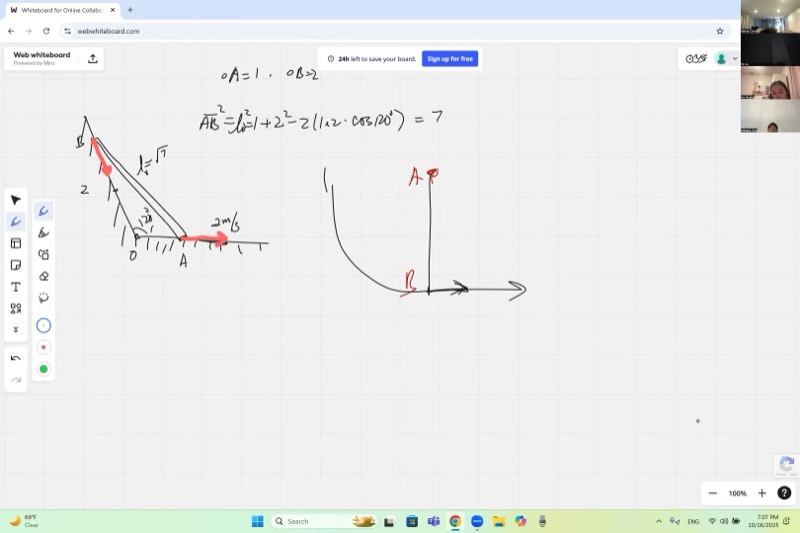
Consider two walls meeting at an angle of \(120°\) at point \(O\). A rigid rod \(AB\) leans against the walls with:
- \(OA = 1\) (distance from the corner to where the rod touches one wall)
- \(OB = 2\) (distance from the corner to where the rod touches the other wall)
We first need the length of the rod \(AB\) using the Law of Cosines:
\[AB^2 = OA^2 + OB^2 - 2 \cdot OA \cdot OB \cdot \cos(120°)\]
\[= 1^2 + 2^2 - 2(1)(2)\cos(120°)\]
Since \(\cos 120° = -\frac{1}{2}\):
\[AB^2 = 1 + 4 - 2(1)(2)\!\left(-\frac{1}{2}\right) = 5 + 2 = 7\]
\[\boxed{AB = \sqrt{7}}\]
Interactive demonstration – the L-shaped wall configuration:
The green segment is the rigid rod \(AB\) with length \(\sqrt{7}\). The two gray lines are the walls meeting at \(120°\) at the origin \(O\).
The Physics (Vector Projection) Method
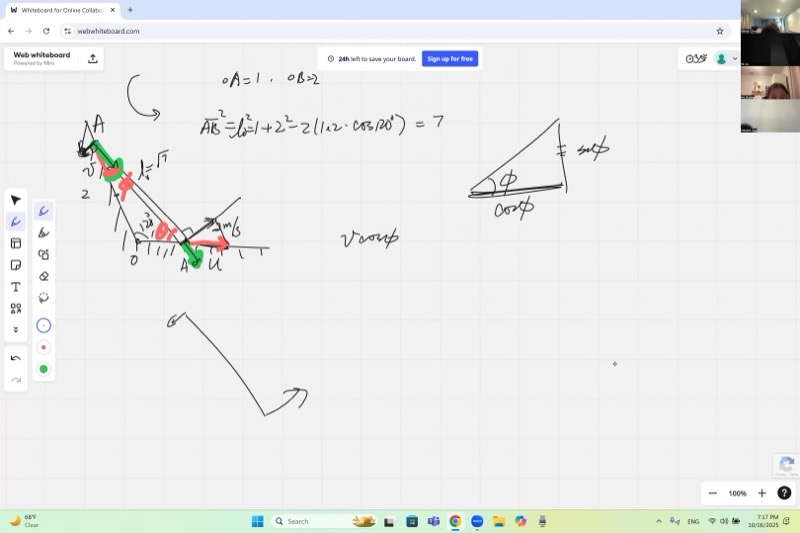
Now suppose point \(A\) is pulled along its wall with a horizontal velocity \(u = 2\) m/s. We seek the velocity \(v\) of point \(B\) along the other wall.
The key insight of the physics method is:
For a rigid rod, the component of velocity along the rod direction must be the same at both ends.
If the radial (along-the-rod) components were different, the rod would be stretching or compressing – which is impossible for a rigid body.
Why the Velocity Must Be Perpendicular to the Rod (Single Fixed Point)
Before tackling the two-moving-endpoints case, consider a simpler scenario: point \(A\) is fixed and only \(B\) can move. What direction can \(B\)’s velocity point?
- If \(B\) had any velocity component along the rod, the distance \(AB\) would immediately start changing – the rod would stretch or shrink.
- So \(B\)’s velocity must be entirely perpendicular to the rod. There is no constraint on the magnitude – \(B\) can move fast or slow, it just has to move sideways.
- Geometrically, \(B\) moves on a circle centered at \(A\), and the instantaneous velocity is tangent to that circle.
Two Moving Endpoints: Decomposing Velocities
When both \(A\) and \(B\) are moving, we decompose each velocity into:
- A radial component (along the rod \(AB\)) – this is the part that would change the rod’s length
- A tangential component (perpendicular to the rod) – this just rotates the rod without changing its length
Let \(\theta\) be the angle between the rod and the wall at end \(A\), and \(\phi\) be the angle between the rod and the wall at end \(B\).
The velocity \(u\) at point \(A\) is along the horizontal wall. Its component along the rod direction is:
\[u_{\text{radial}} = u \cos\theta\]
The velocity \(v\) at point \(B\) is along the other wall. Its component along the rod direction is:
\[v_{\text{radial}} = v \cos\phi\]
Applying the Rigid Body Constraint
Since the rod cannot change length, the radial components must be equal:
\[u \cos\theta = v \cos\phi\]
Solving for \(v\):
For a rigid rod that cannot stretch or compress, the components of velocity along the rod at each end must be equal. This yields a direct formula relating the speeds of the two endpoints – without recourse to calculus.
\[\boxed{v = u \cdot \frac{\cos\theta}{\cos\phi}}\]
No derivatives were required. The velocities are related purely through geometric projection.
Animated demonstration – vector projection along a rigid rod:
Solving the Triangle: Finding \(\cos\theta\) and \(\cos\phi\)
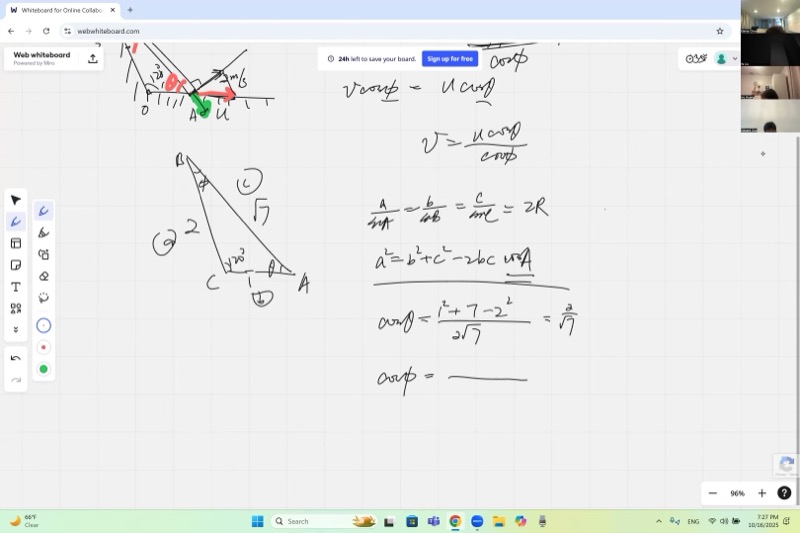
We have a triangle \(OAB\) with sides \(OA = 1\), \(OB = 2\), \(AB = \sqrt{7}\), and the included angle at \(O\) equal to \(120°\).
Finding \(\cos\theta\) (angle at vertex \(A\), between the rod and the horizontal wall):
Apply the Law of Cosines with \(\theta\) as the angle at \(A\):
\[OB^2 = OA^2 + AB^2 - 2 \cdot OA \cdot AB \cdot \cos\theta\]
\[4 = 1 + 7 - 2(1)(\sqrt{7})\cos\theta\]
\[\cos\theta = \frac{1 + 7 - 4}{2\sqrt{7}} = \frac{4}{2\sqrt{7}} = \frac{2}{\sqrt{7}}\]
Finding \(\cos\phi\) (angle at vertex \(B\), between the rod and the other wall):
\[OA^2 = OB^2 + AB^2 - 2 \cdot OB \cdot AB \cdot \cos\phi\]
\[1 = 4 + 7 - 2(2)(\sqrt{7})\cos\phi\]
\[\cos\phi = \frac{4 + 7 - 1}{4\sqrt{7}} = \frac{10}{4\sqrt{7}} = \frac{5}{2\sqrt{7}}\]
Computing the Final Answer
\[v = u \cdot \frac{\cos\theta}{\cos\phi} = 2 \cdot \frac{\;\dfrac{2}{\sqrt{7}}\;}{\;\dfrac{5}{2\sqrt{7}}\;} = 2 \cdot \frac{2}{\sqrt{7}} \cdot \frac{2\sqrt{7}}{5} = 2 \cdot \frac{4}{5} = \frac{8}{5}\]
\[\boxed{v = \frac{8}{5} = 1.6 \text{ m/s}}\]
Notice how the \(\sqrt{7}\) cancels out cleanly – there is no need to rationalize intermediate expressions.
Animated demonstration – approaching velocity decomposed into radial and tangential components:
Proof of the Law of Sines
Uniqueness of the Circumcircle
Every triangle has a unique circumcircle passing through all three vertices. The circumcenter \(O\) must lie on:
- The perpendicular bisector of \(AB\) (equidistant from \(A\) and \(B\))
- The perpendicular bisector of \(AC\) (equidistant from \(A\) and \(C\))
These two lines meet at exactly one point. By transitivity, that point is also equidistant from \(B\) and \(C\), confirming it lies on the perpendicular bisector of \(BC\) as well. This unique point is the circumcenter, and its distance to any vertex is the circumradius \(R\).
The Inscribed Angle Theorem
All inscribed angles subtending the same arc are equal, and each equals half the central angle:
\[\text{Inscribed angle} = \frac{1}{2} \times \text{central angle (arc measurement)}\]
A crucial special case: any angle inscribed in a semicircle equals \(90°\).
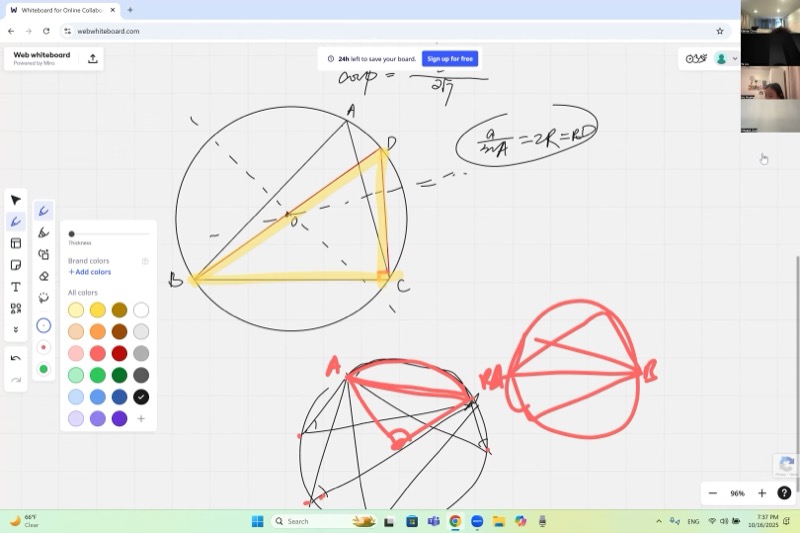
Proving \(\dfrac{a}{\sin A} = 2R\)
Draw the diameter \(BD\) through vertex \(B\). Since \(\angle BCD\) is inscribed in a semicircle:
\[\angle BCD = 90°\]
By the inscribed angle theorem, \(\angle BDC = \angle A\) (both subtend arc \(BC\)).
In the right triangle \(BDC\) with hypotenuse \(BD = 2R\):
\[\sin(\angle BDC) = \frac{BC}{BD} = \frac{a}{2R}\]
Since \(\angle BDC = \angle A\):
\[\sin A = \frac{a}{2R} \implies \frac{a}{\sin A} = 2R\]
By the same argument applied to the other vertices:
In any triangle, the ratio of a side to the sine of its opposite angle is the same for all three sides – and that common value equals the diameter of the circumscribed circle.
\[\boxed{\frac{a}{\sin A} = \frac{b}{\sin B} = \frac{c}{\sin C} = 2R}\]
Interactive demonstration – the circumcircle and the inscribed angle theorem:
Triangle \(ABC\) is inscribed in a circle of radius \(R = 2\). The orange dashed line is the diameter \(BD\). Triangle \(BDC\) is a right triangle (angle at \(C\) is \(90°\)), and angle \(D\) equals angle \(A\) by the inscribed angle theorem.
Rigid Rod on a Circle (Homework Problem)
The following is the second example from class, assigned as homework:
A rod \(AB\) has length equal to one side of a regular hexagon inscribed in a given circle (so the arc \(AB\) subtends \(60°\), meaning \(AB\) equals the radius \(r\)).
Point \(B\) moves radially outward from the center at \(v = 2\) m/s. Point \(A\) is constrained to move along the circle (tangentially). Find the speed of \(A\).
Hints:
- Since arc \(AB\) subtends \(60°\) at the center, the triangle \(OAB\) (where \(O\) is the center) is equilateral – all sides equal \(r\) and all angles equal \(60°\)
- The velocity of \(A\) must be along the tangent line to the circle at \(A\) (perpendicular to the radius \(OA\))
- The velocity of \(B\) is along the radial direction from the center through \(B\)
- Decompose both velocities along the rod direction \(AB\)
- Set the radial components equal (rigid body constraint): \(v_A \cos\alpha = v_B \cos\beta\)
- Use the equilateral triangle geometry to find \(\alpha\) and \(\beta\)
The method is identical to the L-shaped wall problem – only the directions of the constrained motions have changed.
Cheat Sheet
| Formula | What it means |
|---|---|
| \(a^2 = b^2 + c^2 - 2bc\cos A\) | Law of Cosines – find a side or angle in any triangle |
| \(\dfrac{a}{\sin A} = \dfrac{b}{\sin B} = \dfrac{c}{\sin C} = 2R\) | Law of Sines – relate sides to opposite angles and the circumradius |
| \(\cos 120° = -\dfrac{1}{2}\) | Key value used in the L-wall problem |
| \(u\cos\theta = v\cos\phi\) | Rigid body constraint – radial velocity components must match |
| \(v = u\dfrac{\cos\theta}{\cos\phi}\) | Solving for the unknown velocity of the other endpoint |
The Vector Projection Method (Step by Step)
- Identify the rigid rod connecting two moving points
- Determine the direction each point is constrained to move
- Decompose each velocity into radial (along the rod) and tangential (perpendicular to the rod) components
- Set the radial components equal: \(v_A^{\text{radial}} = v_B^{\text{radial}}\)
- Solve for the unknown speed
Key Geometry Facts
\[\text{Inscribed angle} = \frac{1}{2} \times \text{arc (central angle)}\]
\[\text{Angle inscribed in a semicircle} = 90°\]
\[\text{Circumcenter} = \text{intersection of perpendicular bisectors}\]
When to Use Each Method
| Method | Use when… |
|---|---|
| Vector projection (physics) | Two points connected by a rigid rod, each constrained to a known path |
| Calculus (related rates) | General relationships between changing quantities, not limited to rigid rods |