Related Rates — Spheres, Cones, and Propagated Error
Given the rate of increase of a sphere’s surface area, at what rate does its volume grow? How rapidly does the water level rise in a conical funnel? When measuring the height of a structure by observing an angle, how does a small angular error propagate into the computed height? This lesson addresses these questions using a unified three-step procedure: relate the variables, differentiate, and solve. The generality of this method is demonstrated through its applicability to a wide range of problems.
Related rates determine how fast one quantity is changing given the rate of change of a different, connected quantity:
- Medical imaging: as a spherical tumor grows, physicians must determine how fast the volume increases based on surface area measurements from imaging scans
- Engineering: filling a conical storage tank with material – engineers must predict how quickly the level rises to prevent overflow
- Architectural design: when modifying a window while keeping the total framing material constant, related rates determine how changing one dimension forces the other to adjust
- Surveying: measuring the height of a tall structure from the ground using angles – small measurement errors in the angle propagate into errors in the computed height
These problems all follow the same three-step pattern: relate the variables, differentiate with respect to time, and solve.
Topics Covered
- Related rates with spheres: connecting \(\frac{dA}{dt}\) and \(\frac{dV}{dt}\) through an intermediate variable \(r\)
- Multi-variable related rates: French window (rectangle + semicircle) with a constant-circumference constraint
- Cone/frustum water-filling problems using similar triangles to eliminate variables
- Propagated error: relating \(d\theta\) to \(dh\) in indirect measurement
- The three-step procedure: (1) write all variable relationships, (2) differentiate everything, (3) substitute and solve
Lecture Video
Key Frames from the Lecture

Prerequisites
When two variables are related by an equation like \(A = 4\pi r^2\), and both \(A\) and \(r\) change over time, you can differentiate both sides with respect to \(t\):
\[\frac{dA}{dt} = 8\pi r \,\frac{dr}{dt}\]
Every variable that depends on time acquires a \(\frac{d(\cdot)}{dt}\) factor via the chain rule. Constants remain unchanged.
When you have two functions multiplied together, the derivative is:
\[\frac{d}{dt}[f(t) \cdot g(t)] = f'(t)\,g(t) + f(t)\,g'(t)\]
This arises frequently in related rates. For example, differentiating an area \(A = 2rh\) where both \(r\) and \(h\) change over time gives:
\[\frac{dA}{dt} = 2\frac{dr}{dt}\,h + 2r\,\frac{dh}{dt}\]
Two triangles are similar if they have the same angles. This means the ratios of corresponding sides are equal:
\[\frac{a_1}{b_1} = \frac{a_2}{b_2}\]
In cone problems, the cross-section always forms a triangle, and the water level at any height creates a smaller triangle that is similar to the full cone. This gives you a fixed ratio between the radius and height of the water.
Sphere of radius \(r\):
\[A = 4\pi r^2 \qquad V = \frac{4}{3}\pi r^3\]
Cone with base radius \(r\) and height \(h\):
\[V = \frac{1}{3}\pi r^2 h\]
These formulas need not be memorized at this stage – they will be derived later in the course using integration.
A differential like \(dh\) represents an infinitesimally small change in \(h\). When we write:
\[dh = f'(\theta)\,d\theta\]
we mean that a tiny change \(d\theta\) in the input produces a tiny change \(dh\) in the output, scaled by the derivative. Differentials are the building blocks of related rates – the “rates” are just differentials divided by \(dt\).
Key Concepts
Type 1: Sphere – Surface Area and Volume
Problem. A sphere’s surface area increases at \(\frac{dA}{dt} = 7 \text{ m}^2/\text{min}\). Find the rate of increase of the volume.
Step 1 – Relate the variables. Both \(A\) and \(V\) connect naturally through the radius \(r\):
\[A = 4\pi r^2 \qquad V = \frac{4}{3}\pi r^3\]
Step 2 – Differentiate both equations:
\[dA = 8\pi r\,dr \qquad dV = 4\pi r^2\,dr\]
Dividing by \(dt\):
\[\frac{dA}{dt} = 8\pi r\,\frac{dr}{dt} \qquad \frac{dV}{dt} = 4\pi r^2\,\frac{dr}{dt}\]
Step 3 – Eliminate the unknown \(\frac{dr}{dt}\). From the first equation:
\[\frac{dr}{dt} = \frac{7}{8\pi r}\]
Substitute into the second:
\[\frac{dV}{dt} = 4\pi r^2 \cdot \frac{7}{8\pi r} = \frac{7r}{2}\]
When a sphere grows, its volume and surface area both depend on the radius. By differentiating each formula and eliminating the unknown \(\frac{dr}{dt}\), you can directly link the rate of volume change to the rate of surface area change.
\[\boxed{\frac{dV}{dt} = \frac{7r}{2}}\]
The answer depends on the current radius \(r\). This makes physical sense: volume is measured in \(\text{m}^3\) while surface area is in \(\text{m}^2\), so the rate of volume change must carry an extra factor of length.
Animated demonstration – expanding sphere cross-section showing dV/dr:
Interactive demonstration – dependence of \(\frac{dV}{dt}\) on the radius when \(\frac{dA}{dt} = 7\):
The blue line shows \(\frac{dV}{dt} = \frac{7r}{2}\). Drag the slider for \(r\) to see how the volume growth rate is proportional to the current radius.
Type 2: French Window with a Constant Circumference
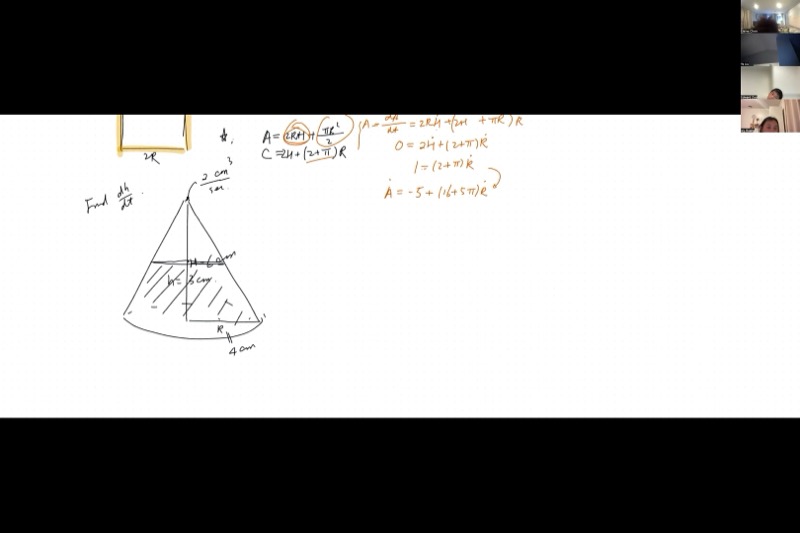
Problem. A French window consists of a rectangle topped by a semicircle. The semicircle has radius \(r\) (so the window width is \(2r\)), and the rectangular part has height \(h\). At this moment, \(r = 5\) and \(h = 8\). The height is decreasing at \(\frac{dh}{dt} = -0.5\). The total framing (circumference) is held constant. Find \(\frac{dA}{dt}\).
Step 1 – Write all equations.
The area of the window:
\[A = 2rh + \frac{1}{2}\pi r^2\]
The total circumference (framing material):
\[C = 2h + (2 + \pi)r\]
Step 2 – Differentiate both.
For the area (using the product rule on \(2rh\)):
\[\frac{dA}{dt} = 2r\frac{dh}{dt} + 2h\frac{dr}{dt} + \pi r\frac{dr}{dt} = 2r\frac{dh}{dt} + (2h + \pi r)\frac{dr}{dt}\]
For the circumference (which is constant, so \(\frac{dC}{dt} = 0\)):
\[0 = 2\frac{dh}{dt} + (2 + \pi)\frac{dr}{dt}\]
Step 3 – Solve. From the circumference equation, isolate \(\frac{dr}{dt}\):
\[\frac{dr}{dt} = \frac{-2\frac{dh}{dt}}{2 + \pi} = \frac{-2(-0.5)}{2 + \pi} = \frac{1}{2 + \pi}\]
Now plug everything into the area equation:
\[\frac{dA}{dt} = 2(5)(-0.5) + \bigl(2(8) + 5\pi\bigr) \cdot \frac{1}{2 + \pi}\]
\[= -5 + \frac{16 + 5\pi}{2 + \pi}\]
The key lesson: when a constraint holds something constant, differentiating it gives you \(\frac{dC}{dt} = 0\), which provides the extra equation you need.
Type 3: Water Filling a Conical Container
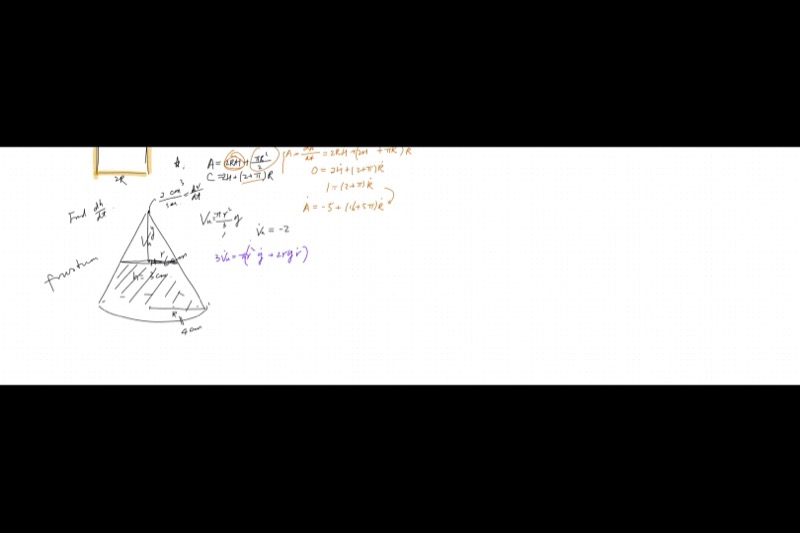
Problem. A cone has base radius \(R = 4\) cm and height \(H = 6\) cm, vertex at the bottom and opening at the top. Water is poured in at \(\frac{dV_{\text{water}}}{dt} = 2 \text{ cm}^3/\text{s}\). When the water reaches \(h = 3\) cm, find \(\frac{dh}{dt}\).
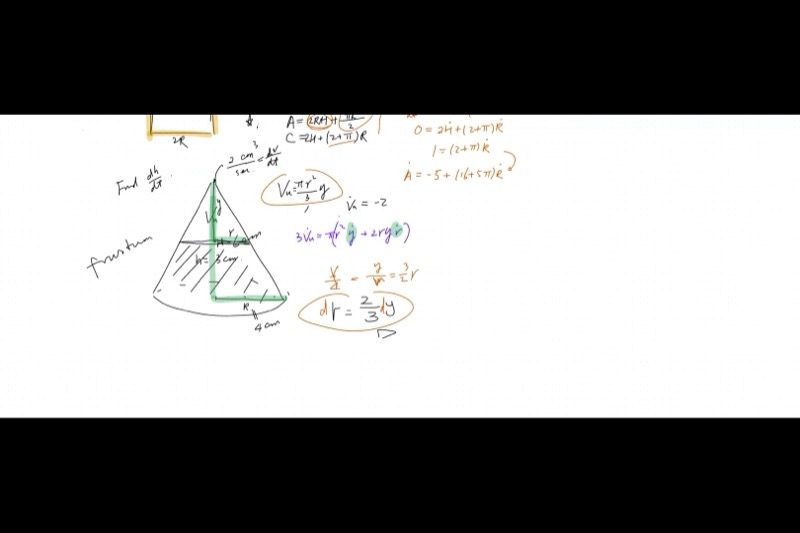
Key observation. Instead of computing the frustum volume, consider the empty cone at the top. Let \(y\) be the height of the empty cone and \(r\) its base radius:
\[V_{\text{up}} = \frac{1}{3}\pi r^2 y\]
Since water is being added, the empty volume is decreasing:
\[\frac{dV_{\text{up}}}{dt} = -2 \text{ cm}^3/\text{s}\]
Use similar triangles. The full cone and the upper empty cone are similar, so \(\frac{y}{r} = \frac{H}{R} = \frac{3}{2}\), giving \(r = \frac{2}{3}y\) and \(\frac{dr}{dt} = \frac{2}{3}\frac{dy}{dt}\).
Substitute to get one variable. Replace \(r\) with \(\frac{2}{3}y\):
\[V_{\text{up}} = \frac{1}{3}\pi\left(\frac{2}{3}y\right)^2 y = \frac{4\pi}{27}y^3\]
Differentiate:
\[\frac{dV_{\text{up}}}{dt} = \frac{4\pi}{9}y^2\frac{dy}{dt}\]
When \(h = 3\), the empty part has height \(y = H - h = 3\) cm:
\[-2 = \frac{4\pi}{9}(3)^2\frac{dy}{dt} = 4\pi\frac{dy}{dt}\]
\[\frac{dy}{dt} = \frac{-2}{4\pi} = \frac{-1}{2\pi}\]
Since \(h = H - y\), we have \(\frac{dh}{dt} = -\frac{dy}{dt}\):
A cone’s cross-section creates similar triangles, which lock the radius and height into a fixed ratio. This lets you rewrite the volume formula in terms of just one variable, making differentiation much simpler.
\[\boxed{\frac{dh}{dt} = \frac{1}{2\pi} \approx 0.159 \text{ cm/s}}\]
Interactive demonstration – the conical container cross-section as water fills:
Drag \(h_0\) to change the water level. The cone is narrower at the bottom, so the same flow rate causes the water to rise faster at lower levels and slower near the wide top.
Animated demonstration – conical tank filling with water:
Type 4: Propagated Error
Problem. You measure the height of a flagpole from 50 m away by reading \(\theta = 45°\). Your instrument is accurate to \(\pm 0.1°\). How much error does this introduce in the height?
Relate the variables. From trigonometry:
\[\tan\theta = \frac{h}{50} \quad \Longrightarrow \quad h = 50\tan\theta\]
Differentiate (no time variable here – just differentials):
\[dh = 50\sec^2\theta\,d\theta\]
Substitute the known values. At \(\theta = 45°\):
\[\cos 45° = \frac{1}{\sqrt{2}} \quad \Longrightarrow \quad \sec^2 45° = 2\]
And \(d\theta = \pm 0.1°\). Converting to radians:
\[d\theta = \pm 0.1 \times \frac{\pi}{180} \approx \pm 0.001745 \text{ rad}\]
Therefore:
\[dh = 50 \times 2 \times (\pm 0.001745) \approx \pm 0.175 \text{ m}\]
So a \(0.1°\) angular error causes about \(\pm 0.175\) m of error in the height. Since \(h = 50\) m, the relative error is about \(0.35\%\).
Propagated error is related rates without the time variable. Instead of \(\frac{dh}{dt}\) and \(\frac{d\theta}{dt}\), one works directly with differentials \(dh\) and \(d\theta\). The key observation: one should not compute \(h(45.1°) - h(45°)\) directly. Instead, treating the small deviation as a differential is more efficient and yields a formula valid for any angle.
Interactive demonstration – dependence of the height error \(dh\) on the measurement angle \(\theta\):
The curve shows the height error \(dh\) (in meters) for a fixed \(d\theta = 0.1°\) as the angle \(\theta\) varies. At steeper angles, \(\sec^2\theta\) grows rapidly, meaning the same angular error causes a much larger height error. The dashed line marks \(\theta = 45°\).
Cheat Sheet
Key Formulas Used
| Quantity | Formula |
|---|---|
| Surface area of a sphere | \(A = 4\pi r^2\) |
| Volume of a sphere | \(V = \frac{4}{3}\pi r^3\) |
| Volume of a cone | \(V = \frac{1}{3}\pi r^2 h\) |
| Tangent relation | \(\tan\theta = \frac{\text{opposite}}{\text{adjacent}}\) |
| Derivative of \(\tan\theta\) | \(\frac{d}{d\theta}(\tan\theta) = \sec^2\theta\) |
Common Pitfalls
| Mistake | Fix |
|---|---|
| Plugging in numbers before differentiating | Keep variables as variables until the very last step |
| Forgetting the product rule when two variables multiply | If \(A = 2rh\) and both change, use \(\dot{A} = 2\dot{r}h + 2r\dot{h}\) |
| Ignoring constraints | A constant quantity has derivative zero – this gives you an extra equation |
| Too many unknowns | Look for geometric relationships (similar triangles, fixed ratios) to eliminate variables |
Propagated Error Formula
If \(y = f(x)\), then the error in \(y\) caused by an error \(dx\) in \(x\) is:
\[dy = f'(x)\,dx\]
The relative error is \(\displaystyle\frac{dy}{y} = \frac{f'(x)}{f(x)}\,dx\).