From Trajectories to Integrals — Antiderivatives and the Area of a Circle
This lesson demonstrates how slicing a circle into infinitesimally thin vertical strips allows calculus to compute curved areas that geometry alone cannot easily handle. We develop the technique of antidifferentiation – the inverse operation to differentiation – and show that inverse trigonometric functions such as arcsine arise naturally in the integration of expressions involving circles. As an additional application, we prove that the trajectory of a horizontally launched projectile is a parabola.
Integration is the second fundamental operation of calculus – it assembles infinitely many infinitesimal contributions to compute totals:
- Pharmacokinetics: the total amount of a drug absorbed by the body over time is obtained by integrating the absorption rate – accurate dosage depends on this calculation
- Aerospace engineering: engineers integrate acceleration data to determine how far a rocket has traveled and its velocity at each instant
- Architectural design: the area of curved surfaces (such as domes and arches) is computed by slicing them into thin strips and summing – this is integration
- Motion analysis: determining the total distance traveled by a moving object requires integrating its speed over time
- Computer graphics: rendering engines use integration to calculate how light reflects off curved surfaces, producing realistic images
Topics Covered
- Projectile motion: recovering position from velocity via antiderivatives (\(x = ut\), \(y = \tfrac{1}{2}gt^2\))
- Eliminating the parameter \(t\) to find the trajectory \(y = \dfrac{g}{2u^2}\,x^2\)
- Introduction to integral calculus: assembling infinitesimals
- Area of a circle by vertical slices: \(dA = 2\sqrt{r^2 - x^2}\,dx\)
- Review of the seven families of functions and their derivative–antiderivative pairs
- Derivative of \(\arcsin x\) via implicit differentiation: \(\dfrac{d}{dx}\arcsin x = \dfrac{1}{\sqrt{1-x^2}}\)
- Derivative of \(\ln x\) via the inverse-function rule: \(\dfrac{d}{dx}\ln x = \dfrac{1}{x}\)
- Antiderivative involving arcsine: \(\displaystyle\int \frac{1}{\sqrt{r^2 - x^2}}\,dx = \arcsin\!\left(\frac{x}{r}\right) + C\)
Lecture Video
Key Frames from the Lecture
Prerequisites
An antiderivative of a function \(f(x)\) is any function \(F(x)\) whose derivative gives back \(f(x)\):
\[F'(x) = f(x)\]
For example, if \(f(x) = 2x\), then \(F(x) = x^2\) is an antiderivative because \(\frac{d}{dx}(x^2) = 2x\).
However, \(F(x) = x^2 + 7\) also satisfies this condition. Any constant added to an antiderivative yields another valid antiderivative, because constants vanish upon differentiation. This is why one writes \(+C\) (an arbitrary constant) at the end.
When a ball is thrown horizontally, two independent motions occur simultaneously:
- Horizontally, the ball moves at a constant speed \(u\) (no horizontal force acts on it)
- Vertically, gravity accelerates the ball downward at a constant rate \(g \approx 9.8\;\text{m/s}^2\)
The horizontal and vertical motions are independent. We describe them with separate equations:
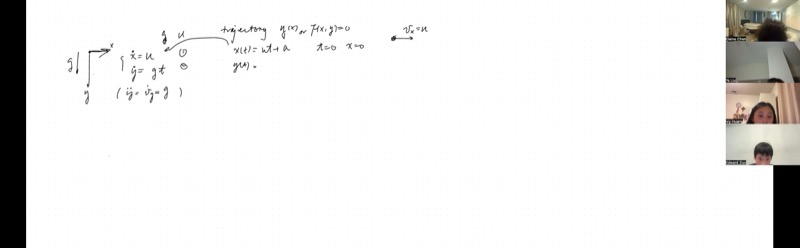
\[\dot{x} = u \qquad \text{(constant horizontal velocity)}\] \[\dot{y} = g\,t \qquad \text{(vertical velocity increases with time)}\]
The dot notation \(\dot{x}\) means \(\frac{dx}{dt}\), the rate of change with respect to time.
In physics, position is often given as two separate equations in time: \(x(t)\) and \(y(t)\). The variable \(t\) is called a parameter.
To find the trajectory (the path the object traces in the \(xy\)-plane), one eliminates \(t\) by solving one equation for \(t\) and substituting into the other. The result is a direct relationship \(y = f(x)\) – the shape of the path, independent of when the object was at each point.
A circle centered at the origin with radius \(r\) is described by the implicit equation:
\[x^2 + y^2 = r^2\]
This is not a function (it fails the vertical line test), but we can solve for \(y\):
\[y = \pm\sqrt{r^2 - x^2}\]
The positive root gives the upper half, and the negative root gives the lower half.
If the derivative of \(x^n\) is \(nx^{n-1}\), then running the rule in reverse gives:
\[\int x^n\,dx = \frac{x^{n+1}}{n+1} + C \qquad (n \neq -1)\]
For example, since \(\frac{d}{dt}(t^2) = 2t\), the antiderivative of \(2t\) is \(t^2 + C\). Equivalently, the antiderivative of \(t\) is \(\frac{t^2}{2} + C\).
Key Concepts
Projectile Motion: From Velocity to Position
Consider the velocity components of a ball thrown horizontally with initial speed \(u\) in a gravitational field:
\[\dot{x} = u \qquad \dot{y} = g\,t\]
Goal: find the trajectory \(y(x)\) by (1) recovering position from velocity, then (2) eliminating \(t\).
Step 1 — Find \(x(t)\). Since \(\dot{x} = u\) is constant, the antiderivative is:
\[x(t) = ut + a\]
Using the initial condition \(x(0) = 0\) (the ball starts at the origin), we find \(a = 0\), so:
\[\boxed{x(t) = ut}\]
Step 2 — Find \(y(t)\). Since \(\dot{y} = gt\) is linear in \(t\), we reverse the power rule:
\[y(t) = \frac{1}{2}g\,t^2 + a\]
Again, \(y(0) = 0\) forces \(a = 0\):
\[\boxed{y(t) = \tfrac{1}{2}g\,t^2}\]
Step 3 — Eliminate \(t\). From \(x = ut\) we get \(t = \frac{x}{u}\). Substituting into \(y(t)\):
\[y = \frac{1}{2}g\left(\frac{x}{u}\right)^2\]
By finding position from velocity (antidifferentiation) and then eliminating time, you can prove that a ball thrown horizontally traces out a parabolic path. Gravity controls how steep the curve is, and the throwing speed controls how flat it is.
\[\boxed{y = \frac{g}{2u^2}\,x^2}\]
This is a parabola. Larger \(g\) makes it steeper (the ball drops faster); larger \(u\) makes it flatter (the ball travels farther before falling).
Interactive demonstration – effect of \(g\) and \(u\) on the trajectory:
Drag \(g\) to increase gravity (the parabola steepens) or increase \(u\) to increase the horizontal speed (the parabola flattens). The ball always follows a parabolic path.
Interactive: Riemann Sum Approximation
Riemann Sum: Area Under a Curve as N Increases
Press “Animate N” to watch the Riemann rectangles refine from \(N=1\) up to \(N=80\). As \(N\) increases, the approximation converges to the exact area. Choose different functions from the dropdown. The error (difference between the approximation and the exact integral) shrinks toward zero.
From Differential to Integral Calculus
Up to this point, the focus has been on differential calculus: decomposing quantities into infinitesimals and finding rates of change. We now begin integral calculus: assembling infinitesimals to compute totals. The key insight is that differentiation and antidifferentiation are inverse operations – as demonstrated by recovering position from velocity in the projectile problem above.
Finding the Area of a Circle
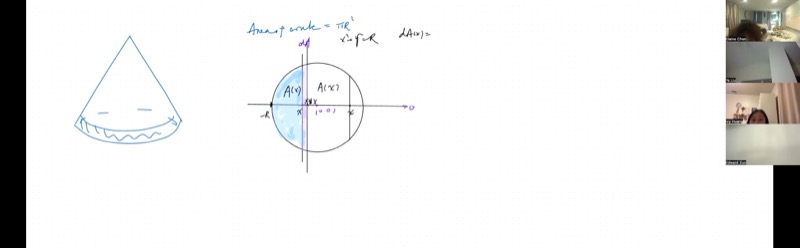
To prove that the area of a circle of radius \(r\) is \(\pi r^2\), we slice it into infinitesimally thin vertical strips and sum their contributions.
Setup. Place the circle \(x^2 + y^2 = r^2\) at the origin. Define \(A(x)\) as the area swept from \(-r\) up to position \(x\):
\[A(x) = \text{shaded area from } {-r} \text{ to } x\]
As \(x\) increases by a tiny amount \(dx\), the area increases by a thin rectangular strip:
\[dA = \text{height} \times \text{width} = 2\sqrt{r^2 - x^2}\;\cdot\;dx\]
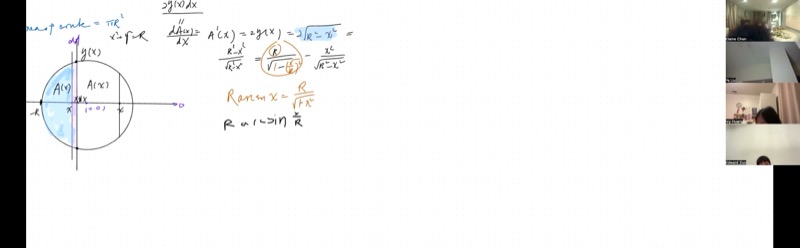
The factor of \(2\) accounts for both the upper and lower halves of the circle. Therefore, the derivative of the area function is:
To find the area of a circle, imagine sweeping a vertical line across it. Each infinitely thin strip has height \(2\sqrt{r^2 - x^2}\) and width \(dx\). The total area is the sum (integral) of all those strips – and finding that sum means finding an antiderivative.
\[\boxed{A'(x) = 2\sqrt{r^2 - x^2}}\]
Now the problem reduces to finding the antiderivative of \(2\sqrt{r^2 - x^2}\).
Interactive demonstration – vertical slicing of a circle:
Drag \(a\) from \(-3\) to \(3\). The shaded blue region is \(A(a)\). The red strip is the infinitesimal slice \(dA\) — its height is \(2\sqrt{9 - a^2}\). When \(a\) reaches \(3\), the shaded area equals the full circle: \(\pi(3)^2 = 9\pi \approx 28.27\).
Interactive: Antiderivative Construction – Area Function Growing
Antiderivative as Area: A(x) = ∫ f(t) dt from a to x
Press “Sweep x” or drag the slider. The top panel shows the integrand \(f(t) = \sqrt{9-t^2}\) with the shaded area growing as \(x\) moves right. The bottom panel shows the area function \(A(x)\) being constructed in real time. When \(x\) reaches \(3\), the total area equals \(\frac{\pi r^2}{2} \approx 14.14\) – half the circle.
Review: Seven Families and Their Derivatives
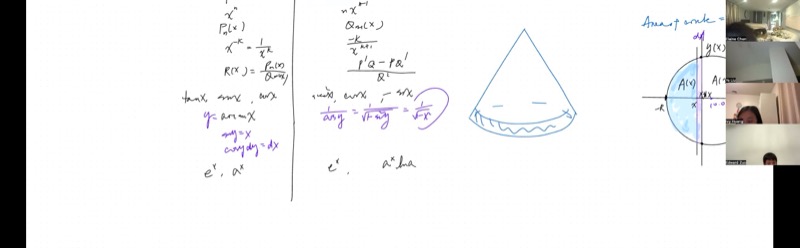
Before tackling the antiderivative of \(\sqrt{r^2 - x^2}\), we review which functions produce which derivatives. Most families are “closed” — the derivative stays in the same family. The key exceptions are the inverse functions.
| Family | \(f(x)\) | \(f'(x)\) | Stays in family? |
|---|---|---|---|
| Power | \(x^n\) | \(nx^{n-1}\) | Yes |
| Polynomial | \(a_nx^n + \cdots + a_0\) | \(na_nx^{n-1} + \cdots\) | Yes |
| Rational | \(\dfrac{p(x)}{q(x)}\) | \(\dfrac{p'q - pq'}{q^2}\) | Yes |
| Trigonometric | \(\sin x,\;\cos x\) | \(\cos x,\;{-}\sin x\) | Yes |
| Inverse trig | \(\arcsin x\) | \(\dfrac{1}{\sqrt{1 - x^2}}\) | No — gives a radical |
| Exponential | \(a^x\) | \(a^x \ln a\) | Yes |
| Logarithmic | \(\ln x\) | \(\dfrac{1}{x}\) | No — gives a rational function |
The crucial observation: when an expression of the form \(\frac{1}{\sqrt{1-x^2}}\) appears and its antiderivative is needed, the answer involves inverse trigonometric functions. When \(\frac{1}{x}\) appears, the answer involves a logarithm. The derivative leaves the family, so the antiderivative returns to it.
Deriving the Derivative of \(\arcsin x\)
Let \(y = \arcsin x\). Then \(\sin y = x\). Differentiating both sides with respect to \(x\):
\[\cos y \;\frac{dy}{dx} = 1 \qquad \Longrightarrow \qquad \frac{dy}{dx} = \frac{1}{\cos y}\]
Now use the Pythagorean identity \(\sin^2 y + \cos^2 y = 1\) to rewrite \(\cos y\):
\[\cos y = \sqrt{1 - \sin^2 y} = \sqrt{1 - x^2}\]
Therefore:
The derivative of \(\arcsin x\) produces a radical expression – it “leaves” the inverse trig family. This means that when you see \(\frac{1}{\sqrt{1-x^2}}\) and need its antiderivative, the answer is \(\arcsin x\). This is exactly the link that lets us integrate circular shapes.
\[\boxed{\frac{d}{dx}\arcsin x = \frac{1}{\sqrt{1 - x^2}}}\]
Interactive demonstration – \(\arcsin x\) and its derivative:
Drag \(a\) between \(-1\) and \(1\). The green tangent line to \(\arcsin x\) (blue) has slope \(\frac{1}{\sqrt{1-a^2}}\) (red dashed). Observe that the slope diverges near \(x = \pm 1\) – the curve becomes vertical there.
Deriving the Derivative of \(\ln x\) and \(a^x\)
Natural log. Let \(y = \ln x\), so \(e^y = x\). Differentiating both sides:
\[e^y \frac{dy}{dx} = 1 \qquad \Longrightarrow \qquad \frac{dy}{dx} = \frac{1}{e^y} = \frac{1}{x}\]
\[\boxed{\frac{d}{dx}\ln x = \frac{1}{x}}\]
General exponential. Let \(y = a^x\), so \(\ln y = x\ln a\). Differentiating: \(\frac{1}{y}\frac{dy}{dx} = \ln a\), giving:
\[\boxed{\frac{d}{dx}\,a^x = a^x \ln a}\]
Antiderivative of \(\dfrac{1}{\sqrt{r^2 - x^2}}\)
Returning to the circle area problem, we need the antiderivative of \(\sqrt{r^2 - x^2}\). We split this into two parts. The first part leads to a term involving \(\frac{1}{\sqrt{r^2 - x^2}}\), which looks similar to the derivative of \(\arcsin x\).
Step 1 — Factor out \(r\). Pull \(r^2\) out of the square root:
\[\frac{1}{\sqrt{r^2 - x^2}} = \frac{1}{r\,\sqrt{1 - (x/r)^2}}\]
Step 2 — Conjecture the antiderivative. Since \(\frac{d}{dx}\arcsin(x) = \frac{1}{\sqrt{1 - x^2}}\), consider \(\arcsin\!\left(\frac{x}{r}\right)\). By the chain rule:
\[\frac{d}{dx}\arcsin\!\left(\frac{x}{r}\right) = \frac{1}{\sqrt{1 - (x/r)^2}} \cdot \frac{1}{r} = \frac{1}{\sqrt{r^2 - x^2}}\]
This matches exactly, so:
\[\boxed{\int \frac{dx}{\sqrt{r^2 - x^2}} = \arcsin\!\left(\frac{x}{r}\right) + C}\]
Step 3 — Scale for the circle area. We need the antiderivative of the full expression \(\frac{r^2}{\sqrt{r^2 - x^2}}\), which appears after rewriting \(\sqrt{r^2 - x^2}\). Multiplying by \(r^2\):
\[\int \frac{r^2}{\sqrt{r^2 - x^2}}\,dx = r^2\,\arcsin\!\left(\frac{x}{r}\right) + C\]
The remaining piece of the circle area (involving \(x\sqrt{r^2 - x^2}\)) has a geometric interpretation as a triangular region – interpreting the arcsine term as a circular sector area reveals the form of the second term.
Interactive demonstration – the arcsine antiderivative and the integrand:
The blue curve is \(\arcsin(x/r)\) (the antiderivative) and the red curve is \(\frac{1}{\sqrt{r^2 - x^2}}\) (the integrand). At every point, the red value equals the slope of the blue curve. Drag \(r\) to change the radius.
Cheat Sheet
| Formula | Meaning |
|---|---|
| \(x(t) = ut\) | Horizontal position under constant velocity \(u\) |
| \(y(t) = \tfrac{1}{2}gt^2\) | Vertical position under constant acceleration \(g\) |
| \(y = \dfrac{g}{2u^2}\,x^2\) | Parabolic trajectory of a horizontal projectile |
| \(dA = 2\sqrt{r^2 - x^2}\;dx\) | Infinitesimal area slice of a circle of radius \(r\) |
| \(\dfrac{d}{dx}\arcsin x = \dfrac{1}{\sqrt{1-x^2}}\) | Derivative of inverse sine |
| \(\dfrac{d}{dx}\ln x = \dfrac{1}{x}\) | Derivative of natural log |
| \(\dfrac{d}{dx}\,a^x = a^x\ln a\) | Derivative of a general exponential |
| \(\displaystyle\int \frac{dx}{\sqrt{r^2 - x^2}} = \arcsin\!\left(\frac{x}{r}\right) + C\) | Key antiderivative for the circle area problem |
The Seven Function Families
\[\frac{d}{dx}(x^n) = nx^{n-1} \qquad\longleftrightarrow\qquad \int x^n\,dx = \frac{x^{n+1}}{n+1}+C\]
\[\frac{d}{dx}(\sin x) = \cos x \qquad \frac{d}{dx}(\cos x) = -\sin x\]
\[\frac{d}{dx}(\arcsin x) = \frac{1}{\sqrt{1-x^2}} \qquad \frac{d}{dx}(\arccos x) = \frac{-1}{\sqrt{1-x^2}}\]
\[\frac{d}{dx}(e^x) = e^x \qquad \frac{d}{dx}(\ln x) = \frac{1}{x}\]
The Inverse Function Derivative Rule
If \(y = f^{-1}(x)\), then:
\[\frac{dy}{dx} = \frac{1}{f'(y)}\]
The derivative of an inverse function is the reciprocal of the derivative of the original function, evaluated at \(y\).